In the standard practice of cartomancy, the novice reader is often taught to treat each card as an isolated lexical unit—a discrete word to be translated, memorized, and stacked alongside its neighbors. Yet, a tarot spread is not a list of definitions; it is a dynamic, living ecosystem. When the eye scans the layout, it should not merely translate individual keywords, but search for resonance. Among the most potent and overlooked of these resonances is the occurrence of repeating symbols in tarot spread layouts. When a specific symbol, color, figure, or posture echoes across multiple cards, it establishes a macro-narrative that transcends the boundaries of any single card.
In the structural methodology of The Tarot Codex, we understand that these repeated occurrences are not mere aesthetic coincidences. They are diagnostic coordinates. Interpreting these patterns requires us to bridge two foundational volumes of our series: Codex V: See the Card Clearly, which details the micro-symbolism of individual cards, and Codex VII: The Tarot Combination Method, which governs spread dynamics and card relationships. By training our eyes to recognize repeated symbols tarot patterns, we move past superficial keyword lookups and begin reading the visual grammar of the spread as a unified field of experience.
The Mechanics of Resonance: Why Repetition Matters
Every tarot card in a deck is crowded with visual arguments—a gate, a winding path, a bird in mid-flight, a specific posture of the hands, or a field of vibrant red. When read in isolation, a symbol acts as a possibility; when repeated, it becomes an imperative. Visual repetition indicates that the subconscious or the situational forces governing the query are locked into a specific frequency. The repetition acts as a visual underlining, signaling that the underlying theme of the repeating symbol has become the dominant atmospheric pressure of the reading.
Furthermore, repetition alters the reading order of the spread. Rather than progressing strictly from left to right, or past to future, a repeated symbol creates a "semantic shortcut." The reader's eye is pulled between the cards that share the symbol, establishing a direct relationship between them. This relationship often reveals the true core of the query—an unresolved pattern, a persistent defense mechanism, or a developmental threshold that the client has met repeatedly but has yet to cross.
The Typology of Visual Echoes: What Can Repeat?
To read symbol patterns in tarot spread layouts with clinical precision, we must categorize what can repeat. Visual echoes generally manifest across eight distinct vectors, each operating in its own symbolic register:
1. Objects and Artifacts
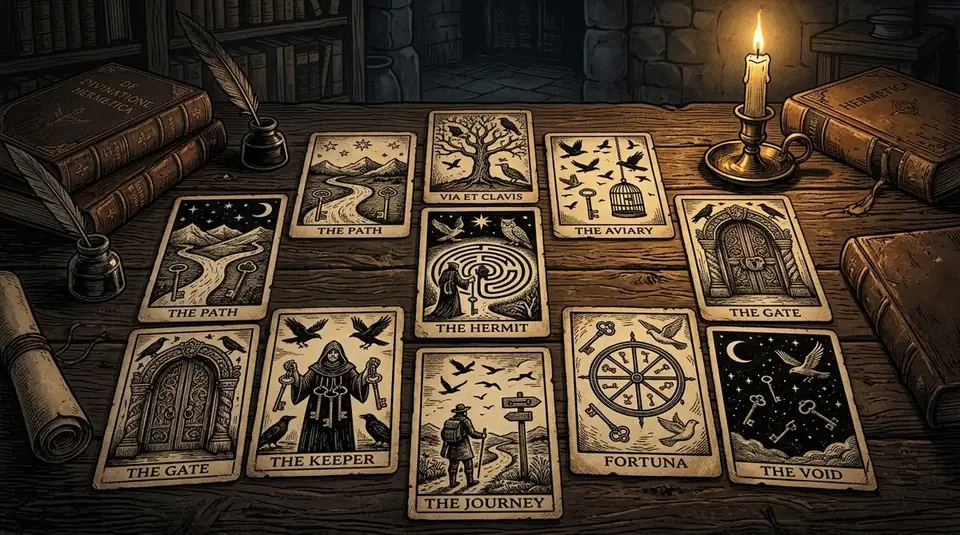
Objects are the instruments of human action, containment, and boundary. When we see objects repeating—such as keys (symbolizing access, secrets, and institutional lockouts), gates or stone walls (representing barriers and thresholds), or cups (representing containment and emotional vessels)—we are looking at the tools the client is using to negotiate their environment. For instance, multiple keys across a spread suggest a situation where the client is searching for answers, but perhaps looking in institutional, rigid places (like the Hierophant) rather than within.
2. Colors and Atmospheric Hues
Colors establish the visceral, emotional climate of a reading. A dominance of a single color across multiple cards is one of the most immediate ways a spread communicates. A repetition of vibrant, primary red (such as the red boots of the Fool, the red robe of the Emperor, and the red sky of the Eight of Wands) points to survival instincts, passion, anger, or root-chakra urgency. Conversely, a repetition of cold, intellectual blues suggests emotional withdrawal, mental detachment, or a need to plunge into the subconscious. Yellow backgrounds or yellow ground indicate the presence of conscious clarity, ego, or solar energy, forcing a mental evaluation of the query.
3. Elements and Suit Patterns
While the complete absence of a suit represents a diagnostic lack (as explored in our guides on no Cups in tarot reading and what missing suits mean in a tarot spread), the repetition of elementally aligned symbols across different suits indicates a concentrated focus. For example, if multiple cards contain elements of blowing wind, stormy seas, or dry, cracked soil, the elemental weather of the spread is active, regardless of the nominal suits drawn. The element is demanding resolution.
4. Body Positions and Gestures
The human body inside the card is a somatic mirror of the client's inner state. When gestures or postures repeat—such as multiple seated figures, multiple figures kneeling, or figures with raised, defensive arms—the spread is mapping a habitual somatic posture. A layout where three figures have their hands hidden beneath robes or clasped tightly to their chests speaks of extreme self-containment, secrecy, or a refusal to offer energy outward. For a deeper analysis of these somatic cues, see our guide on what hands mean in tarot cards.
5. Landscapes and Terrains
The ground beneath a figure's feet determines their stability and path. When landscapes repeat—such as jagged, rocky cliffs (Fool, Seven of Wands), rolling waters (Two of Pentacles, Temperance), or barren, snowy wastes (Five of Pentacles)—the spread is defining the environmental stability of the query. Multiple cards showing unstable, crumbling, or high-altitude terrain indicate that the client feels precarious, exposed, or under intense pressure, regardless of the individual card meanings. For a guide to footing, see what feet and shoes mean in tarot.
6. Numbers and Developmental Cycles
Numerology in tarot is not mystical decoration; it is a structural cycle of stability and disruption. The recurrence of Fours points to temporary stabilization, containment, or stagnation (Four of Wands, Four of Cups, Four of Pentacles). The recurrence of Fives points to disruption, loss, and the breakdown of structure (Five of Cups, Five of Swords, Five of Pentacles). When several cards share a number, the client is locked into that specific phase of development across different areas of their life (e.g., emotional crisis, mental conflict, and material strain occurring simultaneously).
7. Figures and Archetypes
The repetition of specific figures—such as multiple crowned rulers, multiple animal companions, or multiple hooded, solitary figures—reveals the social and relational archetypes at play. A spread populated by solitary pathfinders indicates that the journey must be walked alone, emphasizing self-reliance. A spread with multiple animal guides indicates a need to connect with instinctual, non-rational intelligence.
8. Directions and Gaze Axes
Where the figures look and where their bodies point determines the trajectory of energy. If several figures in a spread are all looking back toward the left margin of the cards, the client’s consciousness is heavily oriented toward the past, regret, or unresolved origins. If they look right, they are searching the horizon for future action. If they face each other, they are locked in confrontation; if they turn away, they avoid the core issue. To study these sightlines, see how to read gaze direction in tarot cards and when tarot cards face each other in a spread.
Repetition vs. Coincidence: The Threshold of Relevance
To practice tarot spread pattern recognition responsibly, the reader must develop a critical filter. The human brain is naturally prone to pareidolia—the tendency to perceive meaningful patterns in random information. If a reader scans a layout and declares a "profound message of flight" simply because one card features a tiny bird in the background and another shows a feather, they are engaging in associative drift rather than structural analysis.
In the Tarot Codex system, we apply three strict criteria to distinguish a diagnostic pattern from a mere coincidence:
- The Rule of Three (Visual Dominance): A symbol pattern is considered structurally dominant when the shared element appears in at least three distinct cards in the layout, or when it appears in two cards that occupy high-leverage positions (such as the heart of the spread and the outcome).
- Visual Prominence: The repeating symbol must be a primary or secondary focal point of the card, not a microscopic detail. A mountain range in the background of the Fool, the Eight of Swords, and the Knight of Pentacles qualifies; a tiny flower on a tunic does not, unless it is central to the query.
- Semantic Consistency: The repeated elements must share a semantic family. A sword, a dagger, and an armored gauntlet represent the same family of steel, defense, and conflict. A flowing river, a falling waterfall, and a cup of water represent the family of fluid emotion and receptive subconscious.
The Five-Step Symbol Map: A Structured Methodology
When you identify a repeating symbol across a spread, do not interpret it immediately. Instead, apply this five-step symbol map to trace its movement and build a diagnostic synthesis:
Step 1: Inventory the Echoes
Scan the spread as a visual canvas. Ignore the traditional card meanings for a moment and list every recurring visual element—whether it is an object, a color, a posture, or a direction. Write them down in order of their visual prominence.
Step 2: Map the Topography
Examine where the repeating symbol is located in each card. Is it held in the hand of a Queen, lying forgotten on the ground, or blocking a path in the background? The location reveals who or what controls the symbol's energy in that phase of the query.
Step 3: Compare the Condition
Observe the physical state of the symbol in each card. Is the repeating object intact in the first card, but broken or spilled in the second? Is the repeating path clear and sunlit in one card, but rocky and shrouded in fog in another? The condition reveals the health and evolution of the theme.
Step 4: Ask What Changes
Trace the transition of the symbol from card to card. What has changed between its first appearance and its last? If a red boot moves from the active, stepping foot of the Fool to the passive, seated foot of the Emperor, the energetic drive is transitioning from raw enthusiasm to structured authority.
Step 5: Form One Interpretive Sentence
Synthesize your observations into a single, direct, diagnostic sentence. This sentence should describe the movement, condition, and resolution of the repeating symbol. This thesis statement becomes the narrative anchor that unites the individual card interpretations.
Diagnostic Case Studies
Let us look at how this five-step method behaves in three diagnostic layouts:
Case Study 1: The Recurrence of the Path
A client asks: "How do I navigate the transition out of my long-term career?"
The cards drawn: The Fool, Eight of Cups, Judgment.
Analysis: The visual path repeats across all three cards.
In the Fool, the path is a narrow, dangerous cliffside edge that the figure ignores, looking up at the sky.
In the Eight of Cups, the path is a rocky, uneven trail leading into dark, cold mountains, walked deliberately at night.
In Judgment, the path is a vertical, cosmic calling where figures rise from stone coffins toward a celestial angel.
Synthesized Sentence: "The client's journey moves from a blind, ungrounded leap (The Fool) into a difficult, conscious departure through the dark terrain of grief (Eight of Cups), culminating in a profound spiritual awakening and alignment with their true calling (Judgment)."
Case Study 2: The Crimson Thread (The Color Red)
A client asks: "How should I handle the conflict with my business partners?"
The cards drawn: The Magician, Five of Swords, Two of Pentacles.
Analysis: The color red repeats: the Magician's outer robe, the red hair and tunic of the victorious figure in the Five of Swords, and the red hood of the dancer in the Two of Pentacles.
In the Magician, red represents active will, passion, and the power to manifest.
In the Five of Swords, red represents the aggressive heat of conflict, ego, and a hollow victory.
In the Two of Pentacles, red represents the physical adaptability needed to balance resources in a shifting environment.
Synthesized Sentence: "The situation began with a high-stakes assertion of creative will (The Magician), which degraded into a destructive, ego-driven battle of power (Five of Swords), and must now be resolved by channeling that energy into flexible, practical adaptability (Two of Pentacles)."
Case Study 3: The Secret Gates (Walls and Portals)
A client asks: "What is blocking my creative progress?"
The cards drawn: Two of Swords, Death, The Star.
Analysis: The gate or wall repeats.
In the Two of Swords, the gate is represented by the stone wall behind the blindfolded figure, blocking access to the deep sea.
In Death, a distant gate stands between two towers on the horizon, framing the rising sun of transformation.
In The Star, the gate is gone; the landscape is completely open, and the bare figure pours water onto the land and sea under the night sky.
Synthesized Sentence: "The creative block is caused by defensive containment and emotional walling-off (Two of Swords), which must undergo a painful but necessary death (Death) to clear the path for perfect, unshielded vulnerability and inspiration (The Star)."
A Visual Checklist for Pattern Recognition
When interpreting a spread, use this checklist to systematically scan for repeating symbols:
- Scan the Canvas: Step back from the table and look at the layout as a single image. What color stands out? What shape repeats?
- Inventory the Elements: List the recurring objects, body positions, landscapes, and directions.
- Apply the Rule of Three: Filter out minor coincidences. Focus on symbols that appear in at least three cards or occupy high-leverage positions.
- Evaluate the State: Note whether the symbol's condition improves, degrades, or remains static across the spread.
- Trace the Sightlines: Draw mental lines between the eyes of the figures. Who is looking at what? What visual conversations are they having?
- Synthesize: Write down your single-sentence thesis before reading the individual card definitions.
Frequently Asked Questions
What if a repeating symbol contradicts the traditional keyword of a card?
In the structural methodology of The Tarot Codex, the visual evidence of the card always overrides the memorized keyword. If a card traditionally associated with joy (like the Four of Wands) contains a repeating symbol that indicates boundary or restriction (such as a stone wall matching other cards in the spread), we must read the card’s joy as protected, walled-in, or limited. Trust the image over the glossary.
How many repeating symbols are required to make a pattern significant?
Generally, a pattern becomes structurally significant when it appears in three or more cards in a layout of five or more cards. In smaller spreads (three cards), a repeated symbol across two cards is enough to form a significant pair, acting as a narrative bridge (see Codex VII for pairing grammar).
Does the repeating color pattern change when using different tarot decks?
Yes. Because different artists employ different color palettes, a pattern that exists in the Rider-Waite-Smith deck may not exist in a historical Marseille deck or a modern minimalist deck. You must always read the specific deck on the table. The artist's choice of color is the reality of that reading, and you must interpret the visual evidence presented in that exact deck.
Can missing symbols or elements be read with the same method?
Absolutely. A diagnostic absence is the flip side of a repeating presence. The complete silence of an element or suit (such as no Swords/Air in a spread about a decision) tells us that the client is avoiding analysis, boundaries, or rational communication, just as a repetition of Swords tells us they are over-analyzing. Both are structural coordinates.
Continue the Method
To master the visual language of tarot, symbol interpretation, and card combinations, explore these essential volumes of The Tarot Codex series: