To lay tarot cards in a spread is to construct a momentary theatre. Most readers approach this layout with a glossary of keywords, treating each card as an isolated island of meaning. Yet, the moment we lay these cards side-by-side, we notice something far more immediate: the figures depicted within the cards are alive with sight. They do not stare blankly into the void. They look, turn, avoid, and confront. When we observe tarot cards facing each other, we transition from the simple vocabulary of individual symbols to the intricate, syntactic grammar of relationship.
This visual relationship is the connective tissue of the reading. By mapping sightlines and spatial dynamics, we uncover an interpretive method that is both rigorous and deeply intuitive. We will explore the mechanics of spread grammar: figures looking at one another, turning their backs, or looking out of the spread.
Why the Visual Relationship Matters in Tarot Spreads
A tarot reading is a dialogue, not a monologue. When multiple cards appear in a spread, they begin to modify one another. Traditional interpretations often rely on memory, trying to fuse keywords like "intellect" and "grief" into a coherent sentence. However, the cards themselves already contain a built-in guide to how they relate: the gaze direction of their figures. For a deeper look at the foundational concepts of gaze, you may read our guide on how to read gaze direction in tarot cards.
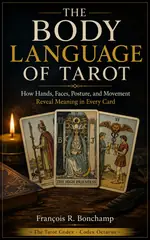
When we ignore where the figures are looking, we miss the psychological tension of the scene. A figure does not merely represent a concept; they represent a point of view. If we have two figures facing each other tarot cards reveal a direct encounter. They are looking at the problem, discussing the term, or confronting the obstacle. If they turn their backs, they are in denial, withdrawing, or operating in separate realities. This spatial grammar allows the reader to see the current layout not as a static list of answers, but as a map of active dynamics. This method is explored in extensive detail in Codex VIII: The Body Language of Tarot (available as the Codex VIII Kindle edition or Codex VIII paperback).
Five Common Patterns of Visual Interaction
When mapping the visual relationship between cards, we look for recurring patterns in how the figures' gazes intersect. These five patterns form the foundation of visual spread grammar:
1. Mutual Gaze (Tarot Cards Looking at Each Other)
When two adjacent cards contain figures that look directly at one another, we call this a mutual gaze. This pattern establishes a strong, energetic loop between the two cards. It suggests:
- Direct Confrontation: The client is facing the issue head-on. There is no avoidance or denial.
- Dialogue and Connection: In a relationship reading, this is the classic sign of active engagement, communication, or conflict that must be resolved face-to-face.
- Resolution: The two forces, though perhaps opposing, are locked in a process of mutual recognition. They cannot ignore each other.
For example, if the Lover card looks directly into the eyes of the Devil, the reading is not about simple temptation; it is about an active, conscious engagement with one’s own shadow or dependencies.
2. Asymmetric Focus (One Looks, One Turns Away)
In this pattern, the figure in Card A looks directly at Card B, but the figure in Card B looks away—either down, up, or out of the spread entirely. This asymmetry reveals an imbalance of attention and energy. It indicates:
- Unrequited Effort: One person or force is putting energy into a situation, while the other is oblivious, disinterested, or actively avoiding it.
- Projection: The figure in Card A is projecting their desires or fears onto Card B, but Card B is occupied with its own internal state.
- Evasion: One side of the equation is trying to initiate a confrontation or dialogue, while the other is refusing to look.
3. Mutual Avoidance (Both Facing Away)
When both figures in adjacent cards turn their backs to one another, looking in opposite directions toward the outer edges of the spread, we have a state of mutual avoidance. This represents:
- Severe Disconnect: A complete breakdown in communication. Neither side is willing to look at the other's perspective.
- Parallel Realities: The two elements of the situation are operating independently, with no shared ground. In relationship readings, this indicates partners who are moving in completely different directions.
- Cold War: An unresolved tension that remains unspoken because both parties are looking away from the point of contact.
4. Centripetal Gaze (Facing into the Center)
In larger spreads, such as a five-card line or a cross, you may find that the figures in the outer cards all look inward toward the center card. We call this a centripetal gaze, which concentrates the reading’s energy on the center card. It suggests:
- Singular Focus: The surrounding cards are all reactions, perspectives, or catalysts for the central theme.
- No Escape: The client’s attention is locked onto the core issue. All roads lead to the center.
- Integration: The various parts of the client's life are working together to resolve or understand the central problem.
5. Centrifugal Gaze (Facing Out of the Spread)
Conversely, when the figures on the outer edges of a spread look outward, away from the layout entirely, they create a centrifugal gaze. Here, the energy escapes the boundaries of the spread. This is where understanding the tarot spread direction meaning becomes essential:
- Seeking External Solutions: The answer does not lie within the current situation. They are looking outside the frame for help, inspiration, or escape.
- Distraction and Evasion: The figures are ignoring the cards on the table because they are looking at what lies beyond them.
- Past vs. Future: In many western decks, a figure looking to the left is looking toward what has already been established (the past or the unconscious), while a figure looking to the right is looking toward the horizon of what is to come (the future or the conscious mind).
How Gaze Direction Alters Specific Reading Types
Applying visual relationships changes how we interpret different types of readings. Let us look at how gaze direction modifies relationship, decision, conflict, and timing spreads:
Relationship Readings
In relationship readings, gaze direction is the ultimate diagnostic tool. If the cards representing two partners are tarot cards looking at each other, it indicates that the relationship is the primary focus of their lives. Even if the cards are difficult (such as the Five of Cups and the Three of Swords), the mutual gaze shows they are experiencing their grief or heartbreak together. If they turn away, the relationship is already fractured by silence, regardless of how positive the individual cards might seem.
Decision-Making Readings
When a client is trying to choose between two paths, we often lay a card for Option A on the left and Option B on the right, with a card representing the client in the center. If the central figure looks toward Option A, their heart and attention are already resolved, even if their conscious mind is still debating. If they look away from both options, it tells us that neither path is the true solution; the client is looking for a third option that has not yet been laid on the table.
Conflict Resolution Readings
When conflict appears in a spread (represented by cards like the Five of Wands or the Five of Swords), look at where the figures are looking. Are they looking at the opponent, or are they looking down at the ground? A figure looking at the opponent represents active engagement and a willingness to fight. A figure looking down indicates shame, defeat, or an internal conflict that is being projected outward onto others.
Timing and Directional Readings
Gaze direction also provides a subtle timing indicator. A card whose figure looks toward the next card in the spread suggests that its energy is moving forward, accelerating the timeline. A card looking backward or out of the start of the spread suggests that the situation is held back by past events, memories, or unresolved debts. By tracing the visual flow, the reader can feel the speed and momentum of the client's journey.
Visual Spread Grammar in Practice: Walkthroughs
To see how this works on the table, let us walk through two specific examples: a three-card layout and a five-card layout.
The Three-Card Example: The Gatekeeper's Boundary
Imagine we lay three cards from left to right for a client asking about a career transition:
- The Fool (Position 1 - Past/Initiation): The figure stands on the cliff, looking up and to the right, stepping forward with optimism.
- The Queen of Swords (Position 2 - Present/Obstacle): The Queen sits on her throne, looking directly to the left, holding her sword upright. She looks straight back at the Fool.
- The Eight of Cups (Position 3 - Future/Outcome): A figure walks away from the cups, moving to the right, looking toward the dark mountains. Their back is completely turned to the Queen of Swords.
The Visual Analysis:
The Fool stands at the beginning, looking forward (right) with eager anticipation. However, he is looking directly into the stern, analytical gaze of the Queen of Swords in the present position. The Queen does not welcome him blindly; she looks back at him, holding up her sword as a boundary. She demands clarity, realism, and truth. This is a classic mutual gaze of confrontation. The Fool’s enthusiasm must answer to the Queen’s intellect.
What is the outcome? The figure in the Eight of Cups turns their back on the Queen of Swords and walks away to the right, looking out of the spread toward the dark mountains. They have realized that they cannot bypass the Queen's test, or perhaps they have integrated her lessons and are now leaving the old structure behind. The visual flow moves from an encounter (Fool and Queen facing each other) to a departure (figure walking away). The story is clear, logical, and visible in the lines of sight.
The Five-Card Example: The Isolated Center
Let us look at a five-card line representing a complex family dynamic:
- Knight of Wands (Card 1): Charges to the right, looking forward.
- Page of Swords (Card 2): Stands defensively, looking to the left, back at the Knight.
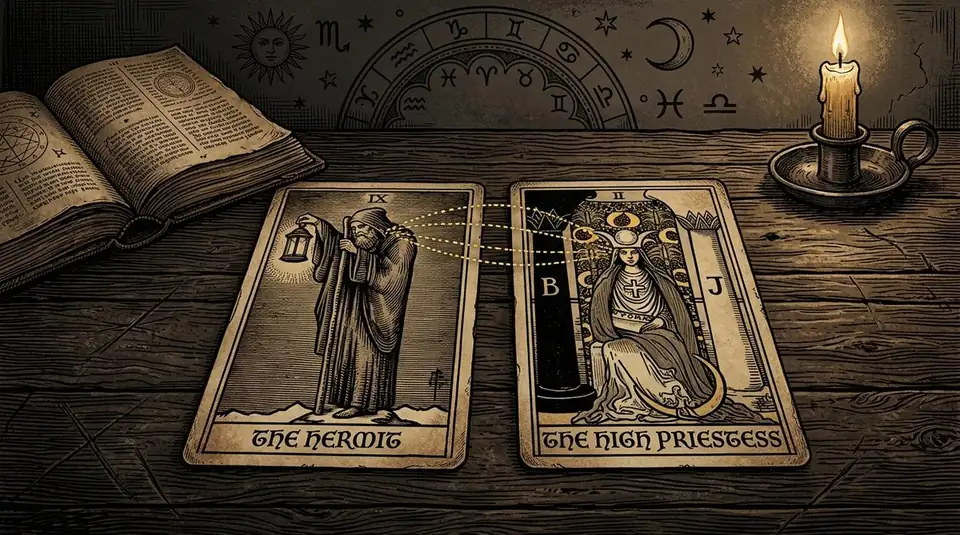
- The Hermit (Card 3 - Center): Stands still, head bowed, looking down at the lantern in his hand.
- Three of Wands (Card 4): Stands on a cliff, looking out to the right, away from the center.
- Four of Cups (Card 5): Sits under a tree, head down, eyes closed, ignoring the cups.
The Visual Analysis:
At the left of the spread, we have an active, high-tension confrontation. The Knight of Wands charges forward, but the Page of Swords turns back to face him, sword raised. They are locked in a mutual gaze of youthful challenge and intellectual defense. They are entirely consumed by their conflict.
In the center, the Hermit stands in complete isolation. He does not look at the conflict on his left, nor does he look at the expansion on his right. His gaze is directed downward at his own light. He is processing something internally, maintaining a strict sanctuary of silence.
To the right, the Three of Wands looks out of the spread entirely, toward the future. He is unconcerned with the Hermit’s silence or the Knight’s battle. His attention is on the horizon. Finally, the Four of Cups sits at the far right, eyes closed, refusing to look at the cup offered to him, refusing to look at the Three of Wands. He is in a state of absolute apathy and withdrawal.
By mapping this spread, the reader can see that the family dynamic is split into three separate theatres: an active conflict (Knight and Page), an internal processing (Hermit), and a future-oriented expansion that is being undermined by apathy (Three of Wands and Four of Cups). The cards show us who is talking to whom, and who is standing in silence.
The Reader's Checklist for Visual Relationship Mapping
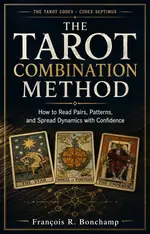
Before you begin interpreting the traditional meanings of your layout, run through this simple checklist to map the visual grammar of the spread. This step-by-step method is detailed in Codex VII: The Tarot Combination Method (available on Codex VII Kindle and in Codex VII paperback):
- Locate all figures: Identify every card that features a human, animal, or personified figure. Note their positions in the spread.
- Determine the sightlines: Trace the line of sight for each figure. Where are their eyes directed?
- Identify intersections: Where do the sightlines meet? Do they crash into another figure (mutual gaze)? Do they land on an empty card? Do they look out of the spread?
- Map the blind spots: What lies behind each figure? What cards are they actively turning away from? What are they ignoring?
- Check the viewer engagement: Is any figure looking directly out of the card at you? This card often represents the client’s conscious self-awareness or the pivot point of the reading.
Frequently Asked Questions
What if a card has no figures? How do I read its gaze?
If a card has no figures (such as the Three of Swords), it represents an environment or environment state. In these cases, we look at how the figures in neighboring cards react to this environment. Are they looking into the card, or are they turning away from it? Their gaze tells us whether they are facing the environment or trying to escape it.
What if a card has multiple figures looking in different directions?
When a card contains multiple figures, it represents an internal group dynamic or a split mind. Map the gaze directions within the card first. Once you understand the card's internal dynamic, look at where the dominant figure is looking relative to the rest of the spread.
How do animal gazes work in tarot?
Animals represent instinctual, somatic, or non-rational forces. If an animal is looking in one direction while the human figure looks in another, it indicates a split between the client’s conscious intellect and their bodily instincts. If they are aligned, it suggests that the client's instincts and intellect are working in harmony.
What if a figure is blindfolded, like in the Two of Swords?
A blindfold is an active denial of sight. It indicates a situation where the client is refusing to look at the evidence, blocking out external sensory input, or trying to make a decision using purely internal reasoning. In a spread, a blindfolded figure represents a complete block in the visual flow; they cannot see the neighboring cards, and their decisions are made in the dark.
Continue the Method
To master the visual language of tarot, including gaze, body language, and sight-based interpretation, explore these essential volumes of The Tarot Codex series: