When beginners learn tarot, they are usually handed a booklet of keywords. They memorize that the Page of Cups means "creative opportunities" and the Five of Cups means "loss." But when they look at the cards, they miss the most striking detail: the human figures inside the cards are actively looking at things. In the method of The Tarot Codex, we teach that a card speaks first through its visual scene. And one of the most powerful elements of any visual scene is the gaze direction of its figures.
Where a figure looks reveals their focus, attention, desire, avoidance, memory, and relationships. It tells us whether they are facing their problems, escaping into the past, looking to the future, or completely ignoring the options in front of them. When you read multiple cards in a spread, their lines of sight interact, creating a visual conversation that can confirm or completely contradict the traditional keywords. (To learn more about reading the human form in cards, see our article on body language in tarot).
The Six Modes of Gaze in Tarot
To read gaze direction with discipline, you must look closely at where the eyes of the figure are directed. We categorize gaze into six distinct modes:
1. Looking at the Viewer (Eye Contact)
When a figure looks directly out of the card at the reader (such as the figure in the Four of Cups, the Justice card, or the Fool), it creates direct engagement. This mode suggests:
- Direct confrontation with the client’s current reality.
- An invitation to self-reflection: the card is looking at you, asking you to witness yourself.
- Consciousness, transparency, or a situation where nothing is hidden.
2. Looking Away (Into the Distance)
When a figure looks toward the side of the card, past the immediate scene (like the two figures in the Three of Wands or the Hermit looking off-canvas), it represents projection and transition. This suggests:
- Looking toward the future or planning what is to come.
- A lack of focus on the immediate, present environment.
- Longing, anticipation, or waiting for news from afar.
3. Looking Downward
When a figure casts their eyes down toward the ground, their feet, or a specific object (like the mourning figure in the Five of Cups or the resting figure in the Four of Swords), it indicates internal processing. This suggests:
- Introspection, grief, depression, or shame.
- Focus on what has been lost, broken, or left behind.
- Concentration on a specific, immediate task (like the craftsman in the Eight of Pentacles).
4. Looking Upward
When a figure looks toward the sky, the clouds, or a higher point in the image (like the figure in the Seven of Cups looking at the floating chalices, or the figures in Judgement looking toward the angel), it represents aspiration and external influence. This suggests:
- Idealism, dreaming, spiritual hope, or looking for divine guidance.
- Distraction from the physical earth; floating in fantasy.
- Awe, revelation, or feeling overwhelmed by a force larger than oneself.
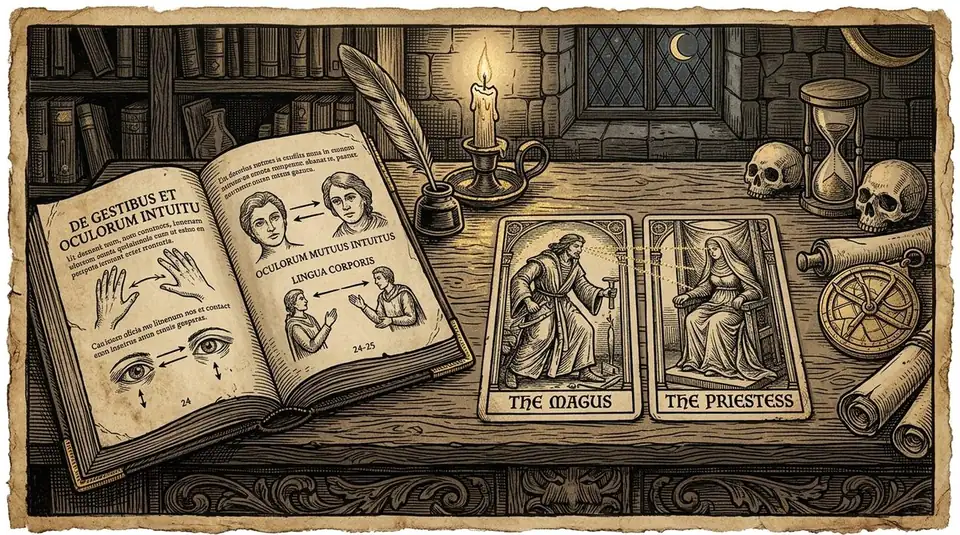
5. Looking Toward Another Card (Spread Level)
In a spread, when a figure in Card A looks directly toward Card B, it creates an active link between those two situations. The figure in Card A is paying attention to, desiring, or reacting to the event in Card B. For example, if a Knight of Swords looks directly at a Three of Swords, he is charging directly into the heartbreak.
6. Avoiding Another Figure or Card
Conversely, when a figure actively turns their head or gaze away from an adjacent card or another figure in the same card (like the figure in the Four of Cups ignoring the cup offered by the hand in the cloud), it indicates avoidance, refusal, denial, or a boundary. They do not want to see what is happening next to them.
Gaze in Single Cards vs. Spread-Level Readings
We must distinguish between the gaze within a single card and how gaze behaves across a complete spread.
Within a single card, gaze establishes the internal psychological state of the character. In the Eight of Cups, the figure walks away from the cups, looking forward into the dark mountains. His gaze is aligned with his direction of movement; there is no looking back. He is resolved. In contrast, in the Five of Cups, the figure stands still, head bowed, staring only at the three spilled cups. He cannot see the two upright cups behind him because his gaze is locked onto the floor. The physical restriction of his sight explains his emotional state.
Across a spread, gaze becomes the relational grammar of the reading. It tells us how the different areas of the client’s life are interacting. When cards are placed next to each other, their figures will either look at each other, look in the same direction, or look away from each other. This creates three primary visual dynamics:
- Face-to-Face (Confrontation or Connection): When two figures look directly at each other across cards, it indicates relationship, debate, conflict, or direct engagement. They are dealing with the issue.
- Aligned Gaze (Shared Direction): When figures in different cards all look in the same direction (e.g., all looking to the right), it suggests a shared focus, a forward-moving momentum, or a collective avoidance of what lies to the left.
- Back-to-Back (Disconnect or Avoidance): When two figures look away from each other, it points to a profound lack of communication, separate realities, or a refusal to face the other card's theme.
How to Create a "Gaze Map" of a Spread
Before you recite the meaning of the cards, draw a mental "gaze map" of the reading. Use this repeatable checklist:
- Identify all figures: Note every card that contains a human, animal, or personified figure (including angels or mythological creatures).
- Draw the lines of sight: Literally trace where each figure is looking. You can use your finger to draw the line from their eyes across the spread.
- Check for eye contact with the viewer: Is anyone looking directly at you? That card is the core psychological pivot of the reading.
- Analyze the intersections: Where do the lines of sight land? Do they hit other figures? Do they hit empty spaces? Do they look completely out of the spread?
- Notice the blind spots: What is being ignored? If a figure is looking to the right, what is happening on the card to their left that they are not seeing?
Three Common Mistakes to Avoid
When applying gaze direction to your readings, be careful to avoid these three traps:
1. Treating Left and Right as Fixed Fate
Some schools of tarot teach rigid rules, such as "looking to the left always means looking at the past" and "looking to the right always means looking at the future." In the method of The Tarot Codex, we reject this rigidity. Left and right are relative. A figure looking left may be looking at a card that represents a current resource, not the past. Read the relationships between the actual cards in the spread, not an abstract timeline.
2. Ignoring Deck Differences
Gaze directions vary wildly between different tarot decks. A figure looking down in the Rider-Waite-Smith deck might be looking up in the Tarot de Marseille or a modern deck. Always read the specific, physical card that is on the table in front of you. Do not read the memory of a card; read the image that is actually present.
3. Over-Symbolizing Every Glance
Not every tiny glance is a major spiritual revelation. Sometimes a figure looks down because they are walking on a rocky path (like the Fool). Use common sense: look for the most prominent lines of sight that establish the structure and tension of the spread, rather than analyzing the pupils of every background figure.
Frequently Asked Questions
What if a card has no figures? How do I read gaze?
If a card has no figures (such as the Three of Swords or the Ten of Pentacles in some decks), it represents an environment or a field of force rather than a person's perspective. In this case, the lines of sight from figures in neighboring cards will look *into* this environment, showing how they react to that energy.
How do animal gazes work in tarot?
Animals (like the dog in the Fool, the lion in Strength, or the horses in the Chariot) represent instinctual, somatic, or non-rational forces. If an animal is looking in a different direction than the human figure, it indicates a split between the client’s conscious intellect and their bodily instincts.
What if a figure is blindfolded, like in the Two of Swords?
A blindfold is an active denial of gaze. It indicates a situation where the client is refusing to look at the evidence, blocking out external sensory input, or trying to make a decision using purely internal reasoning. It is the ultimate expression of a closed line of sight.
Continue the Method
To master the visual language of tarot, including gaze, body language, and sight-based interpretation, explore these essential volumes of The Tarot Codex series: