When a seeker sits before a tarot spread, their eyes are naturally drawn to the towering archetypes of the Major Arcana or the elemental symbols of the suits. Yet, in the silent theater of the cards, the most profound dramas are often enacted in miniature. They are found in the curve of a finger, the tension of a fist, the angle of an offering palm. In the interpretive methodology of The Tarot Codex, we establish that a card must be read as a visual scene before it is reduced to a semantic keyword. To look at hands in tarot cards is to witness intention made visible. The hand is the primary anatomical instrument of agency, serving as the bridge between the internal landscape of the soul and the external material reality of the world.
When we ignore the hand gestures of the figures, we strip the cards of their psychological nuance. A keyword like "security" for the Four of Pentacles is a flat caricature compared to the visual reality of a figure locking his arms, clutching a coin to his chest, and anchoring others under his feet. The hand is where power, vulnerability, and relationship are negotiated. To read a card without observing the hands is like reading a play without watching the actors' gestures. By studying the specific configurations of the hand—whether they are open, closed, holding, offering, pointing, crossed, or releasing—the reader unlocks a precise, visual syntax. This syntax transforms the reading from a mechanical recitation of definitions into a living, relational dialogue. (For a broader look at visual mechanics, see our guide on why tarot is a symbolic language).
The Seven Typologies of Hand Gestures in Tarot
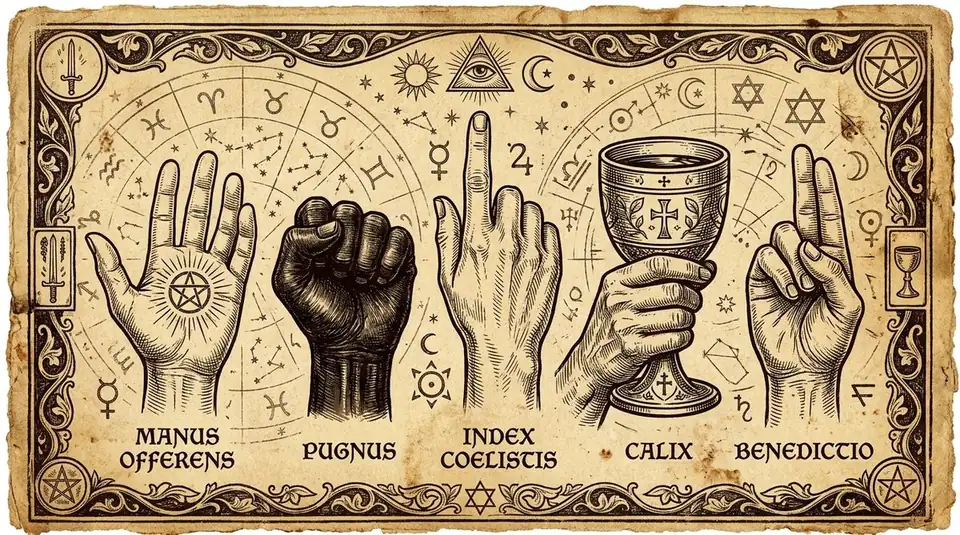
To read the human form in the cards with discipline, we must categorize the behavior of the hands. In our study of the body language in tarot, detailed in Codex VIII: The Body Language of Tarot, we identify seven primary typologies of hand gestures. Each represents a distinct orientation of the will toward the self or the environment.
1. Open Hands in Tarot: Receptivity and Flow
The posture of open hands in tarot is a sign of non-resistance, vulnerability, and receptivity. An open hand does not grasp or hoard; it allows energy to pass through. In the Star card (XVII), the figure's hands are relaxed and open, pouring water onto both the fertile earth and the pool without tension, serving as a conduit for renewal. Open hands suggest that the querent should practice surrender and remain receptive to what the universe is offering. (To understand how this flow interacts with sight, see our guide to how to read gaze direction in tarot cards).
2. Closed Hands in Tarot: Containment and Grasp
Conversely, closed hands in tarot represent containment, defense, boundaries, and control. The closed fist (pugnus) or the tightly gripping hand indicates that the figure is holding onto power, wealth, grief, or an idea with intense effort. We see this in the Four of Pentacles, where the seated figure holds a coin with both hands pressed against his chest, his arms forming a closed box. His grip is defensive, born of a fear of loss. Closed hands ask the reader what is being hoarded and what boundary is being enforced at the cost of connection.
3. Hands Holding Objects: Agency and Responsibility
When a hand is depicted holding an object, we must ask not only what is being held, but how it is held. The act of holding (tenere) indicates that the figure has integrated the object’s energy into their active life. In the Court Cards, the Queen of Pentacles holds her coin with both hands, cradling it in her lap. Her grip is not the defensive clutch of the Four of Pentacles, but a nurturing, protective hold, suggesting stewardship. In contrast, the Knight of Swords grips his sword with a single, white-knuckled hand, raising it high. The hand holds the weapon not as a resource to be guarded, but as an extension of his immediate, aggressive will. The manner of holding reveals whether the object is a burden, a tool, a treasure, or a weapon.
4. Hands Offering: The Transaction of Trust
The gesture of offering (manus offerens) is a bridge between two entities, acting as an invitation or a gift. The most pure examples are found in the Ace cards of the Minor Arcana, where a radiant hand emerges from a cloud, offering a Wand, a Cup, a Sword, or a Pentacle. This is the hand of the cosmos, presenting a latent potential. In the Six of Cups, we witness a human offering: a child passes a cup containing a white flower to another child. The hands are soft, indicating a pure transaction of memory or affection. When reading the offering hand, look at the neighboring card: who is receiving the offer? Is the figure in the adjacent card looking toward the gift, or are their hands closed and turned away?
5. Hands Pointing: Direction and Authority
The pointing hand (index) is an instrument of direction, command, and focus. It organizes space and dictates attention. In the Magician (I), one hand points upward with a double-pointed wand toward the heavens, while the other hand points downward to the earth, channeling divine inspiration into material manifestation. The pointing hand tells the reader where the power is moving. It asserts, "Look here," or "This is the path," indicating where the querent should direct their attention.
6. Hands Crossed or Hidden: Defensive Boundaries and Secrets
When hands are crossed over the chest or hidden beneath robes, the figure is actively withdrawing their agency from the outer world. In the Two of Swords, the blindfolded woman sits with her arms crossed over her chest, holding two massive swords upright. This posture creates a shield over her heart and throat, refusing to drop the weapons or make a decision. She has closed her lines of sight and her physical agency. Hidden or crossed hands suggest that the querent is keeping secrets, protecting themselves from a hostile environment, or in a state of suspended animation.
7. Hands Releasing or Dropping: Surrender and Defeat
The act of releasing or dropping an object represents the final stage of a cycle—either voluntary surrender or involuntary loss. In the Five of Swords, the two defeated figures in the background have dropped their weapons; their empty hands hang loosely at their sides as they walk away. They have surrendered their agency. Conversely, in the Star, the deliberate pouring out of water is a conscious release. Releasing hands ask: what must be let go? Is the surrender a painful defeat, or is it the necessary clearing of space for something new to emerge?
The Object in Hand: Why What We Hold Modifies the Gesture
In the study of tarot iconography, we cannot separate the hand from the object it touches. As we outline in Codex V: See the Card Clearly, the material and symbolic nature of the object modifies the psychological meaning of the gesture. What figures hold in tarot dictates the specific channel through which their will is expressed.
A hand holding a sword is negotiating the realm of intellect, boundary, and conflict. The grip must be firm, for a sword is sharp and dangerous; a loose grip invites self-injury, while an overly tight grip indicates anxiety and hyper-vigilance. A hand holding a cup is holding water—the element of emotion, intuition, and relationship. The hand must cup and cradle, forming a vessel to support the vessel. If the hand clutches the cup too tightly, the water spills; if it holds it too loosely, the cup falls. A hand holding a wand is holding wood, the element of fire and action. The grip is vertical, ready to strike or plant. A hand holding a pentacle is holding metal or stone, the element of earth and material reality. The hand acts as a scale, weighing the object’s worth, or as a vault, securing its safety.
When analyzing a card, observe the exact point of contact between the skin and the symbol. Is the figure touching the blade of the sword (indicating sacrifice or pain, as in the Three of Swords), or are they holding the hilt (indicating control)? Are they balancing the pentacle on their fingertips (like the juggler in the Two of Pentacles), or are they gripping it with their claws (like the Devil)? This point of contact is the precise location where the figure's psychological energy meets their physical reality.
Visual Examples Across the Arcana
To ground these concepts in practice, let us examine how hand gestures function across different sections of the deck. This structural division helps us see how gestures shift from cosmic archetypes to daily human labor.
The Major Arcana: The Cosmic Hand
In the Major Arcana, hands represent archetypal states of being. In the Emperor (IV), the figure holds an orb in one hand and a sceptre in the other. His hands do not touch each other; they are separated, representing the compartmentalized control of his empire. In Strength (VIII), the woman's hands are placed directly on the jaws of the lion. There is no rope or weapon. Her hands are soft, holding the beast with a gentle confidence that represents the sovereignty of spirit over animal instinct. In the Hanged Man (XII), the figure’s hands are bound behind his back. He has no physical agency in the material world; his hands cannot grasp, build, or fight. His work must be entirely internal, a triumph of surrender and perspective.
The Court Cards: The Social Hand
The Court Cards represent roles and social dynamics, and their hands reveal their operational style. The Page of Wands holds his staff with both hands, looking up at it with curiosity; he is still learning the weight of his element. The Knight of Wands grips his staff with one hand, riding at a gallop; he uses it as an instrument of momentum. The Queen of Wands holds a sunflower in one hand and a wand in the other, her hands wide apart, welcoming her court. The King of Wands holds his staff firmly, his other hand resting on his throne, showing complete mastery. By comparing the hand gestures of the courts, we see how maturity shifts from the tentative, two-handed grip of the Page to the relaxed, authoritative control of the King.
The Minor Arcana: The Human Hand
In the Minor Arcana, hands perform the daily labor of life. In the Eight of Pentacles, the craftsman uses a hammer and chisel; his hands are focused entirely on his work, representing disciplined, repetitive effort. In the Three of Wands, the figure rests his hand on one of the standing poles, looking out at the sea. His hand is relaxed, using the wand as a support while he waits for his ships to return. In the Nine of Wands, the bandaged figure holds his staff with both hands, leaning against it defensively. His hands are his last line of defense; they are tense, braced for another attack.
The Tarot Hand Gestures Observation Checklist
When conducting a reading, use this repeatable visual checklist to map the hands in the spread. This method is detailed further in Codex I: Tarot by Sight.
- Locate the Hands: Scan each card and identify where the hands of the figures are positioned. Are they visible, or are they hidden under robes, behind backs, or off-canvas?
- Count the Active Hands: Note how many hands are actively engaging with the scene. A figure with one hand hidden may be keeping a secret or holding back a resource.
- Classify the Gestures: Use the seven typologies (open, closed, holding, offering, pointing, crossed, releasing) to identify the primary posture of each hand.
- Examine the Grip: Study the tension of the hands. Is the grip tight, loose, balanced, or strained? Does it represent security, panic, mastery, or fatigue?
- Trace the Sightlines and Handlines: Draw a line from the eyes of the figure to their hands, and then from their hands to the object or figure they are touching or pointing toward.
- Analyze Spread Interactions: Check how the hands interact across adjacent cards. Is a figure in Card A pointing their finger at a figure in Card B? Is a hand in Card B offering a cup that the figure in Card C is ignoring?
Frequently Asked Questions
What if a figure's hands are completely hidden under a cloak, like the Hermit?
Hidden hands represent concealed agency or the withdrawal of action from the material world. The Hermit (IX) keeps his hands hidden under his cloak, holding only his lantern aloft. His focus is not on doing, but on seeing. Hidden hands suggest that the querent must focus on internal wisdom rather than external action, keeping their plans quiet until the light of understanding has cleared the path.
What does it mean when a hand appears from a cloud, as in the Aces?
A hand emerging from a cloud represents cosmic intervention. It is the "Hand of God" (manus Dei), a classical art-historical motif showing that a new spark of energy is being introduced into the querent's life from a source beyond their conscious control. The hand is always open and offering, representing a pure gift of elemental potential that the querent must choose to grasp and develop.
Does the left hand mean something different than the right hand in tarot?
Yes. In traditional iconography, the right hand (dexter) is associated with active execution, logic, and outward giving. The left hand (sinister) is associated with the subconscious, receptivity, and receiving. For example, the Magician points his right hand to the heavens and his left hand to the earth, representing the receipt and redirection of energy. Observe which hand is holding the weapon or offering the cup to determine if the action is conscious or instinctual.
What if a card has no figures or hands visible?
If a card has no figures (such as the Eight of Wands or the Three of Swords), it represents a force field, an environment, or a clean elemental event rather than a human perspective. In a spread, look at the figures in the adjacent cards. Are they reaching their hands into this empty card? Are they shielding their faces from it? The neighboring hands show how the human element reacts to this environmental energy.
Continue the Method
To master the visual language of tarot, including gaze, body language, and sight-based interpretation, explore these essential volumes of The Tarot Codex series: