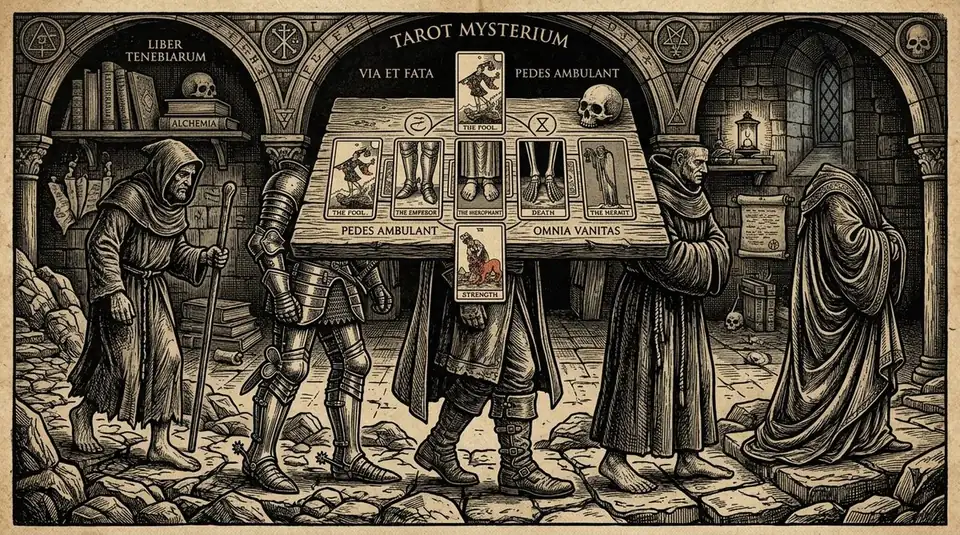
In the theater of the tarot, our eyes are naturally drawn to the crown, the cup, the sword, and the gaze. We scan the faces of queens and the heavy clouds of the sky, seeking the intellectual and emotional climate of the query. Yet, a card’s true stance is decided at its lower boundary—where the figure meets the ground. To ignore the feet is to ignore the foundation of the entire posture. In the structural methodology of The Tarot Codex, we understand that a card speaks from the ground up. The presence, position, and covering of the feet reveal how a figure is anchored, where they are headed, and what price they pay for their journey.
Understanding the role of feet in tarot requires us to develop a dual sensitivity. We must look first at the foot itself as an organ of contact, and second at the shoe as an artifact of protection and status. When we examine the lowest register of the image, we ask: Is this figure grounded in raw, immediate reality, or are they insulated from it? Are they poised to flee, anchored to stand, or caught on a crumbling ledge? By analyzing these somatic signals, we can move past generic keywords and read the physical grammar of the spread with clinical precision.
The Anatomy of Grounding: Feet as Contact and Direction
The feet are the body’s primary interface with the earth. Physically and symbolically, they represent grounding—the capacity to remain connected to the immediate material plane. In a tarot reading, the state of a figure's feet tells us how they relate to the "here and now."
First, the feet denote contact. They are the points through which the earth's gravity pulls us down, and through which we push back to stand tall. When a figure has firm contact with the soil, they possess stability; when they float, hover, or sit with feet tucked away, the card operates in a realm of abstraction, intellect, or spiritual suspension.
Second, the feet establish direction. The tarot walking direction—whether a figure's toes point to the left, the right, or straight at the viewer—is one of the most critical narrative elements in a spread. The feet are the vanguard of intent. A figure’s face may look back in regret (as in the Five of Cups), but if their feet are oriented toward the right margin, their physical body is already migrating into the future. The feet do not lie; they reveal the true trajectory of the client’s energy, regardless of their mental distractions.
Finally, the feet represent readiness and the path. The ground beneath a figure is rarely flat. It is rocky (The Fool), watery (Temperance), or snowy (Five of Pentacles). The feet tell us how the figure is negotiating this terrain. Are they vulnerable to the cold, or are they heavily armored against the sharp stones? The answer determines whether the path is being experienced directly or survived defensively.
The Shell of Footwear: Shoes as Protection and Status
If the bare foot represents raw contact, the shoe represents mediation. The shoes in tarot meaning is deeply bound to the concept of the "persona"—the social mask we wear to navigate the outer world. A shoe is a technology of protection; it insulates the vulnerable flesh from the heat, cold, and sharp edges of the earth.
When we observe shoes in the cards, we are witnessing a choice of defense and role. Shoes tell us about:
- Protection: A shoe allows a figure to traverse hostile environments without suffering immediate pain. The red boots of the Fool or the heavy leather shoes of the pathfinder permit travel across jagged cliffs.
- Status and Role: In the medieval and Renaissance iconographies that birthed the tarot, footwear was a primary marker of class and profession. Armored sabatons belong to knights; fine slippers belong to royalty; bare feet belong to peasants, saints, and fools. The shoe tells us what social role the figure has assumed to deal with the situation.
- Social Readiness: A person in boots is prepared to walk, work, or fight. A person with bare feet or soft slippers is either in a sanctuary (like the Star) or exposed to the elements (like the impoverished figures in the Five of Pentacles).
- Distance from Direct Experience: While a shoe protects, it also insulates. A figure wearing thick, rigid boots cannot feel the texture of the soil. They are separated from the earth. In psychic terms, heavy footwear represents a rationalized, guarded approach to life, where the client is protected from hurt but also cut off from direct, raw feeling.
The Typology of Footing: A Comparative Study
To read footwear and feet systematically, we must categorize the various states of footing found across the deck. We distinguish six primary types of footing:
1. Bare Feet: The Sacred Exposure
The bare feet tarot symbolism is one of the most spiritually charged visual cues in the deck. To walk barefoot is to strip away social armor and status. It represents:
- Vulnerability and Innocence: The figure in The Star pours water onto the land and sea, completely barefoot. She has no defenses, no persona, and no distance from the elements. She is in perfect, unmediated contact with the cosmos.
- Sacred Ground: In many spiritual traditions, one removes their shoes on holy ground. Bare feet appear on cards where the experience is direct and mystical. The Fool’s bare ankles (in some historical decks) or the Hermit’s unclad feet suggest that their journeys are not social, but spiritual.
- Deprivation: Conversely, in the Five of Pentacles, the snow-dusted ground is traversed by figures with bare or poorly wrapped feet. Here, bareness is not a spiritual choice but a sign of material neglect, vulnerability, and exposure to life's harshest winters.
2. Armored Feet: The Steel of Preparation
Armored boots, or sabatons, are found on the Knights, the Charioteer, and sometimes the Emperor.
- Role and Readiness: Armored feet indicate that the figure has entered a state of war or high-stakes competition. They are prepared to stomp over obstacles, and their footing is impervious to external attack.
- Rigidity: The price of armor is immobility. A knight cannot run, dance, or feel the grass. His footing is heavy and loud. In a reading, armored feet suggest that the client is handling a situation with extreme defensiveness or force, which protects them from injury but prevents them from adjusting to subtle shifts in the emotional landscape.
3. Hidden Feet: The Secrets of the Hem
In many of the seated Major Arcana cards—specifically the High Priestess, the Empress, the Hierophant, and the Emperor—the feet are completely obscured by heavy, cascading robes.
- Inaction and Stability: Hidden feet indicate that movement is not the current objective. The figure is anchored in their seat of power, representing structural stability, institutional authority, or deep contemplation.
- Withholding: When feet are hidden under the hem of a robe (especially in the High Priestess), it suggests that the path forward is secret, internal, or not yet ready to be revealed. The client is advised to wait, gather knowledge, and sit with the mystery rather than rushing into action.
4. Walking Feet: The Kinematics of Departure
Dynamic, walking feet are characterized by one foot planted forward while the heel of the back foot lifts off the ground (as seen in the Eight of Cups, the Knight of Wands, or the Fool).
- Transition: Walking feet show that the present state is temporary. The figure is in mid-stride, moving between domains.
- Departure: In the Eight of Cups, the figure's feet carry them away from the stacked chalices and toward the dark hills. The lift of the back heel is the visual proof of abandonment; the decision has been made, and the body is already in motion.
5. Planted Feet: The Double Anchor
Planted feet are both resting flat on the ground, sharing the weight of the body equally (as in Justice, the Emperor, or Temperance).
- Equilibrium: Planted feet show that the figure has reached a state of balance or decision. They are not easily swayed by external forces.
- The Double Realm: In Temperance, we see a unique variation of planted feet: one foot is placed on the dry land, while the other is immersed in the flowing water. This is the ultimate symbol of dual containment—the ability to keep one foot grounded in the material world (Earth) while the other remains receptive to the psychic, emotional currents (Water).
6. Unstable Footing: The Shifting Soil
Unstable footing is marked by figures who are slipping, falling, or standing on precarious surfaces (such as in the Tower, the Ten of Swords, or the Five of Wands).
- Crisis: When the ground itself is denied or shifting, the client’s foundation is compromised.
- Conflict and Chaos: In the Five of Wands, the figures stand on uneven, patchy ground, their feet angled in chaotic directions. Their physical instability mirrors their social and mental conflict. They cannot mount an effective effort because their foundation is constantly slipping.
Posture, Weight, and Gaze: Reading the Body's Foundation
In the system of The Tarot Codex, we do not analyze symbols in isolation. The feet must always be read in context with the rest of the body’s posture. When conducting a posture reading, observe how the weight of the figure is distributed:
- Leaning Forward: If the feet are planted but the torso leans heavily forward (like the figure in the Seven of Wands), it indicates defensiveness, strain, and anticipation of conflict. The feet are acting as braces against an oncoming force.
- Leaning Backward: If the weight is thrown onto the back foot while the front foot is lightly touching the ground, it reveals hesitation, skepticism, or a desire to retreat.
- The Angle of the Feet: Check the angle of the stance. A wide, open stance (like the Emperor) represents territorial dominance and a refusal to budge. A narrow, closed stance suggests self-containment, fear, or a desire to slip away unnoticed.
Furthermore, compare the direction of the feet with the direction of the gaze. If the feet are walking to the right but the eyes are looking back to the left, there is a profound division between the figure's physical path and their mental focus. They are moving forward, but their mind is trapped in the past. This visual tension is often the core diagnosis of the entire reading.
Diagnostic Examples from the Arcana
Let us look at how these principles manifest in specific readings:
Example 1: The Fool's Red Boots
In the Rider-Waite-Smith deck, the Fool stands at the edge of a precipice, his feet clad in vibrant red boots. Red is the color of passion, action, and the physical root chakra. Although the Fool’s gaze is directed upward toward the heavens, his red boots connect him to the physical world of action and travel. The boots protect him, allowing him to step off cliffs without the immediate fear of the rocks. His footing is light, almost dancing, showing that he does not carry the weight of experience. If his feet were bare, his journey would be one of immediate, painful exposure; the boots show that he is cushioned by a certain cosmic innocence.
Example 2: The Two of Pentacles' Dancing Footing
The figure in the Two of Pentacles balances two heavy coins while standing on one foot, the other lifted in a dance. Behind him, the sea tosses ships on violent waves. This is the footing of dynamic adaptation. The figure cannot plant both feet flat because the ground is constantly shifting, just like the waves behind him. To survive, he must remain in motion, shifting his weight from one foot to the other. In a reading, this tells us that security is not found in static standing, but in the willingness to dance with change.
Example 3: The Six of Swords' Passive Passengers
In the Six of Swords, a ferryman steers a boat containing two cloaked passengers. The passengers are huddled, their feet completely hidden from view. Unlike the ferryman, who has his feet firmly planted on the deck of the boat to exert leverage, the passengers have surrendered their footing entirely. Their hidden feet show that they have no agency, no ability to steer, and no direct contact with the path. They are being carried. This indicates a transition where the client must accept passivity and allow others to steer the ship.
A Visual Checklist for Reading Feet and Shoes
When interpreting a spread, use this systematic checklist to analyze the foundation of the cards:
- Check for Visibility: Are the feet visible, or are they hidden under robes, water, or the frame of the card?
- Identify the Footwear: Is the figure barefoot, in soft shoes, in riding boots, or in armored plates? What does this choice of covering say about their defense and social role?
- Determine the Stance: Are both feet flat (planted), is one heel lifted (walking), or is the figure suspended (floating/seated)?
- Trace the Direction: Which way do the toes point? Does this direction align with the figure’s gaze, or is there visual tension between where they are looking and where they are walking?
- Analyze the Ground: What is the quality of the soil beneath them? Is it stable, rocky, icy, or watery? How does the footwear match the terrain?
Frequently Asked Questions
Why do some figures have one foot in the water and one on land?
This dynamic, seen most famously in Temperance and the Star, represents the bridge between the conscious mind (land/earth) and the subconscious mind (water). It shows a figure who is capable of navigating both the rational, material world and the fluid, emotional depths of the psyche without drowning or drying out.
Does 'bare feet' always mean poverty or spiritual purity?
No. Context determines the meaning. In a card of celebration like the Four of Wands, bare feet indicate joy, comfort, and sanctuary—being "at home" and relaxed. In the Five of Pentacles, it indicates deprivation and vulnerability. Always look at the emotional temperature of the card and the surrounding spread.
What does it mean when a figure has mismatched shoes or feet?
Mismatched footing or shoes (found in some historical decks or specialized modern decks) indicates a split in the figure's approach to life. It suggests they are trying to walk two different paths simultaneously, or that their inner desires (one foot) are out of alignment with their public role (the other foot).
How do I read walking direction when cards are placed vertically?
When cards are stacked vertically, the walking direction still operates on a left/right axis, but it also introduces an axis of ascent and descent. A figure walking "out" of the column is leaving the core issue, while a figure walking "into" the column is entering the heart of the conflict.
Continue the Method
To master the visual language of tarot, including physical gestures, body alignment, and symbol reading, explore these essential volumes of The Tarot Codex series: