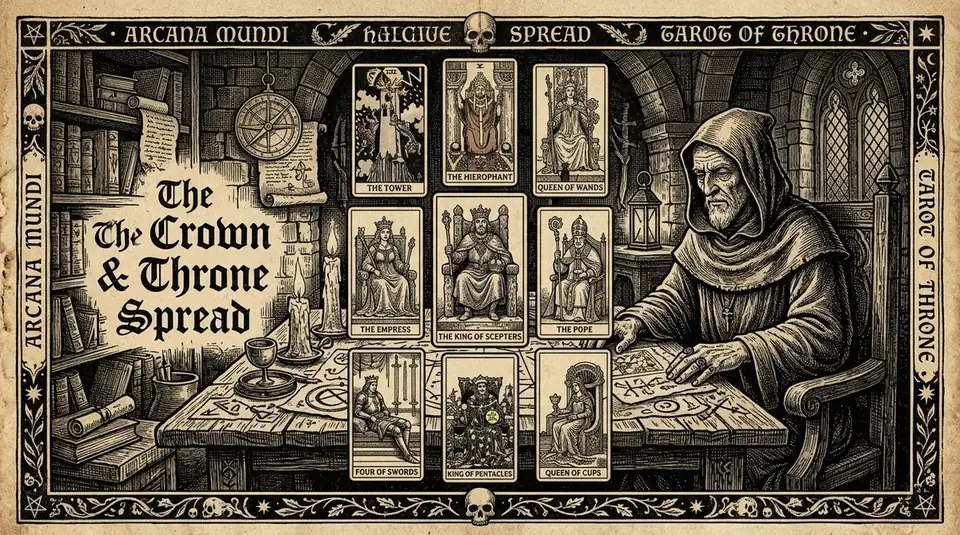
In the quiet theatre of a tarot spread, figures do not merely stand or speak; they occupy spaces defined by structure, boundary, and garments. Among the most potent and visually commanding elements of this grammar are the authority symbols tarot displays: the crown and the throne. In the methodology of The Tarot Codex, we resist the superficial urge to read these emblems of royalty as simple indicators of literal power or victory. Instead, we approach them as somatic and spatial technologies of mediation. They are tools that define a figure's relationship to their domain, their subjects, and their own interior worlds.
To study crowns in tarot is to examine the elevation and isolation of the ego, the crystallization of responsibility, and the ascent from physical action to spiritual or intellectual sovereignty. Conversely, to analyze thrones in tarot meaning is to look at stability, containment, structural immobility, and the public office that separates the individual from the raw earth. Much like the cold metal plating analyzed in the symbolism of armor in tarot cards, crowns and thrones insulate their wearers, creating a calculated distance that protects their position while demanding an unyielding physical and psychological price.
The Crowning of the Head: Ego, Ascent, and Sovereignty
The crown is a circle of metal that sits upon the head—the seat of the intellect, the ego, and the higher chakras. In tarot crown symbolism, the crown represents the externalization of the mind's authority. By wearing a crown, a figure announces that their thoughts are no longer private; they have been elevated to the status of law, rule, or spiritual doctrine. This elevation, however, carries a profound burden.
In visual grammar, we analyze the crown through three distinct symbolic dimensions:
- The Elevation of the Ego: The crown physically extends the height of the figure, forcing the observer's gaze upward. Understood through the lens of psychological development in Codex V, this signifies the ego's attempt to master the lower, instinctual drives of the body by focusing energy entirely in the head.
- Inherited Role versus Earned Authority: A crown can be a heavy crown of gold inherited by bloodline, or a laurel wreath earned through victory. The inherited crown demands that the wearer match the institution they represent, while the earned crown represents individual agency and accomplishment.
- The Separation from the Soil: Just as heavy footwear cushions a figure's step, a crown draws the center of gravity upward. The crowned figure is no longer grounded in the simple, instinctual mud of life; they live in the rarefied air of responsibility.
The Sovereign Crown: Major Arcana Archetypes
The Major Arcana displays a rich taxonomy of crowns, modifying the nature of the authority expressed by the archetype. In The Emperor (IV), the crown is rigid and closed, echoing the heavy stone plates of his throne. It is an instrument of secular, structural authority. It represents the ego crystallized into law, a mind that has armored itself against doubt and emotional currents.
In contrast, The Empress (III) wears a crown of twelve stars. This is not an earthly crown of mined gold, but a celestial crown connected to the cosmos, the zodiac, and the natural cycles of growth. Her authority is not maintained through stone walls or iron laws, but through her alignment with the fertile rhythms of the universe. It is a receptive, generative sovereignty that cultivates rather than conquers.
The spiritual dimension of the crown shifts further when we observe The High Priestess (II), who wears the horned tiara of the triple moon. Her crown represents receptive spiritual authority, indicating that her mind is a vessel for hidden, nocturnal knowledge. She does not rule over an empire; she guards the threshold of the unconscious.
Conversely, The Hierophant (V) wears a heavy, tiered triple crown—the tiara of dogmatic, institutionalized spiritual power. This crown represents vertical hierarchy, a structured pathway where divine revelation is codified into human law, demanding obedience and the preservation of sacred structures.
The ultimate diagnostic moment for the crown occurs in The Tower (XVI). Here, a crown of gold is violently blasted from the summit of a stone tower by a bolt of lightning. This is the absolute displacement of the inflated ego. The crown, which once represented the peak of human achievement, is revealed as a fragile ornament, cast down into the abyss along with the figures who sought shelter behind its stone walls.
The Architecture of the Seat: Thrones in Tarot
If the crown is the peak of authority, the throne is its foundation. To sit upon a throne is to be stabilized, anchored, and contained. In thrones in tarot meaning, the seat of power is never just a chair; it is an architectural monument that structures the body of the ruler and defines their relation to the earth.
We analyze the throne through three primary structural dynamics:
- Immobility and Stability: A throne is massive, often carved from stone, wood, or solid metal. By sitting on a throne, a figure renounces physical mobility in exchange for institutional power. The ruler remains seated, forcing the world to come to them. This immobility can represent profound stability, but it can also represent stagnation.
- The Separation from the Ground: The throne is usually placed on a dais, elevated above the floor of the court. This elevation establishes a vertical hierarchy. The ruler looks down upon their subjects, creating a visual and psychological distance that prevents intimacy but reinforces command.
- The Integration of the Body and the Institution: The throne is a frame. It forces the body into a rigid, upright posture. The person sitting on the throne must conform to the shape of the seat; they cannot slouch or relax. The throne represents the office itself—the individual sacrifice personal comfort to embody the collective structure.
The Stone and the Cushion: Major Arcana Seats
Observe the stark contrast between the thrones of the Major Arcana. The materials, decorations, and placement of these seats reveal the nature of the power they support.
The throne of The Emperor (IV) is a massive, cushionless grey stone block decorated with ram heads. This unyielding monument represents permanence and the coldness of impersonal law. The Emperor sits upright, aligned with the hard angles of the rock, showing that his authority is built on defense, structure, and active control of his environment.
Contrast this with the cushioned, red velvet throne of The Empress (III). Surrounded by a lush forest and golden wheat fields, her seat is not a rigid barrier but a comfortable, receptive space integrated with the landscape. Her throne represents organic abundance, luxury, and the nurturing flow of life.
In Justice (XI), the stone throne stands between two massive pillars, draped with a heavy veil. Justice sits in perfect symmetry, holding a sword and scales. Her throne represents absolute balance and cosmic law; it permits no movement or leaning, symbolizing a state of impartial judgment where personal bias is stripped away.
Somatic Modifiers: Gaze, Hands, and Posture
In the interpretive system of The Tarot Codex, we do not read symbols in isolation. The meaning of a crown or a throne shifts dynamically depending on the figure's somatic posture, their gaze, and the gestures of their hands. As developed in Codex VIII, the body language of the sovereign determines whether their authority is active, defensive, receptive, or decaying.
1. The Gaze of Command and Reflection
Where does the crowned figure look? The direction of their gaze changes the relationship between their authority and the reader:
- The Direct, Frontal Gaze: Figures like the Emperor, Justice, and the Hierophant look directly out of the card, making eye contact with the reader. This is a confrontational, public gaze. It demands that the reader answer to their authority or submit to their law. It is the posture of direct, active administration.
- The Profile or Off-Camera Gaze: Many Queens and Kings in the Minor Arcana look away, focusing on their suit symbols or gazing into the distance. This profile gaze represents internal reflection, detachment, or vision. The figure is not engaged with the public; they are contemplating their responsibilities.
2. The Grammar of the Hands
The hands of the ruler reveal how they execute their authority. As analyzed in the study of what hands mean in tarot cards, the hands are the active extensions of the mind's intent. Holding a scepter in the right hand (the active hand) represents the projection of will and command. Holding an orb or globe in the left hand (the receptive hand) represents the containment and preservation of the domain. If a figure holds both, they represent a balanced expression of power. Conversely, when a queen rests her hand gently on her lap or holds her symbol with a soft, open gesture, she is cultivating the qualities of her suit rather than enforcing them. Her power is nurturance, not domination.
The Court Cards: The Living Court on and off the Throne
In the system of The Living Court, detailed in Codex IV, court cards are read as dynamic roles and stages of psychological development rather than static personality types. The presence, shape, and absence of crowns and thrones across the court ranks allow us to diagnose the maturity of the client's energy. For a deeper understanding of how these roles operate, explore our guide on how court cards really work.
1. The Queens: Receptive Containment
The Queens sit on their thrones, wearing crowns that are integrated with the natural elements of their suits. Their authority is internal, reflective, and containing. They do not ride out to conquer; they hold space, managing the emotional, intellectual, or material resources of their domains from a stable center. Each Queen carries her throne and crown differently:
- The Queen of Cups: Her throne is decorated with sea-monsters at the water's edge, representing the containment of deep, psychic currents. She gazes intensely at a closed chalice, holding her emotional depth without drowning.
- The Queen of Pentacles: Her throne is nestled in a lush, green garden. She cradles her pentacle on her lap, representing the nurturing, preservation, and quiet enjoyment of material stability.
- The Queen of Swords: She sits on a stone throne high above the clouds. She holds her sword upright, her butterfly crown representing intellectual distance and absolute clarity.
- The Queen of Wands: Her throne is adorned with lions and sunflowers, and a black cat sits at her feet. She holds a wand, representing the containment of passion and creative fire.
2. The Kings: Structural Administration
The Kings also sit on thrones and wear prominent crowns, but their posture is more active, structural, and externally oriented. Their thrones represent the institutional laws that organize their suits, while their crowns represent their public duty to rule.
- The King of Swords: He sits on a high, stone throne, ruling through reason, truth, and structural policy. He is the ultimate judge, but his stone seat offers no warmth.
- The King of Cups: His throne floats on a stone block in the middle of a churning ocean, representing the mastery and containment of emotion through structure.
- The King of Wands: His throne is decorated with lions and salamanders. He holds a wand and leans forward as if ready to stand; his throne is a temporary launchpad for action.
- The King of Pentacles: He sits on a throne decorated with bull heads, surrounded by the stone walls of his castle, representing material success, empire, and structural security.
3. The Knights and Pages: The Un-throned Movement
To truly understand the meaning of the throne, we must look to where it is absent. The Knights and Pages of the court have no thrones. The Knights ride horses, clad in armor, representing movement, pursuit, and defense. The Pages stand on their feet, holding their suit symbols with curiosity, representing learning and potential. The absence of the throne indicates that these figures are not yet bound by the responsibilities of office. They have the freedom of movement, but they lack the structural authority and stability of the Kings and Queens.
Diagnostic Interpretations: Reading Authority in Spread Contexts
When crowns and thrones appear in a diagnostic tarot reading, they act as indicators of how the client is managing their personal power, boundaries, and identity. Use these three scenarios to guide your interpretation:
1. The Throne as a Cage: Institutional Rigidity
If a King or Queen appears in a position of challenge or block, it suggests that the client is trapped by their own role. They have become so identified with their "throne" (their job, their social status, or their family role) that they can no longer move. They are paralyzed by the need to maintain their image of strength and stability. The advice of the card is to step off the dais, unlace the crown, and reconnect with the raw earth of their personal desires.
2. The Floating Crown: Inflation of the Ego
When a crowned figure appears next to cards of instability or chaos, or if the Tower is nearby, it indicates an inflation of the ego. The client is attempting to rule a situation through sheer willpower or arbitrary authority, without having built the necessary structural foundation. They are wearing a crown but have no throne to support them. The advice is to focus on building stability from the ground up.
3. The Empty Throne: Relinquished Sovereignty
If cards of exhaustion, defeat, or confusion surround a court ruler, or if reversed figures appear, it suggests that the client has abandoned their sovereign center. They have allowed others to dictate their boundaries, leaving their throne empty. The reading diagnoses a need to reclaim their personal authority, sit upright in their life, and establish clear, non-negotiable boundaries.
Frequently Asked Questions
Does a crown in a tarot card always represent pride or ego?
No. While a crown can represent ego inflation or rigid pride, it also symbolizes necessary responsibility, mental clarity, and spiritual alignment. It indicates that the figure has risen above immediate emotional reactions to govern their life from a place of higher vision.
What is the difference between the throne of the Emperor and the throne of Justice?
The Emperor's throne is decorated with ram heads and represents secular, protective, and territorial power focused on control. The throne of Justice is situated between two pillars and represents cosmic, objective, and impartial balance aligned with universal law.
Why do Knights wear armor but have no thrones, while Kings have both?
Knights represent the active movement and pursuit of their suit's goals. They do not sit on thrones because they do not have a permanent domain to govern. Kings represent the mature, established structure of the suit. They sit on thrones to administer their empire and wear armor to show that their structural rule is backed by vigilant defense.
Continue the Method
To master the visual grammar of tarot—including the interpretation of symbols, court roles, and somatic postures—explore these essential volumes of The Tarot Codex series: