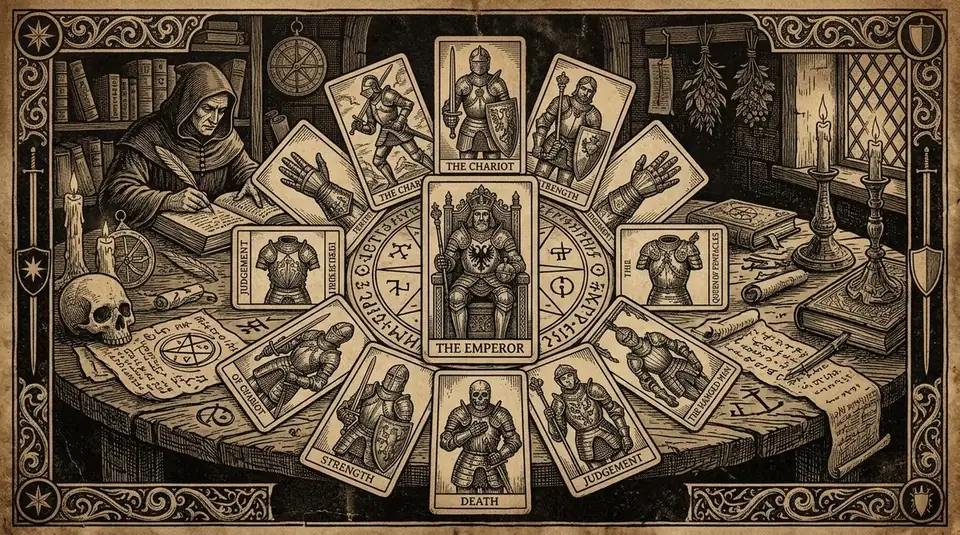
In a tarot spread, we naturally look to facial expressions and hand gestures. Yet, some of the most profound statements are made by what is hidden. When a figure retreats behind a steel carapace, they make a statement about boundary, vulnerability, and role. In the methodology of The Tarot Codex, we treat armor in tarot cards not as a simple shorthand for battle, but as a technology of mediation—a physical boundary negotiating the space between the vulnerable self and a hostile environment.
To understand the role of armor tarot symbolism, we must look past the narrative of war. Armor is a garment of steel. Like the heavy leather boots studied in the symbolism of feet and shoes in tarot, armor insulates the wearer from direct experience. While a shoe protects only the feet, armor covers the heart, throat, limbs, and brain, changing the figure's weight, mobility, and relational capacity. By studying what armor means in tarot, we learn to recognize the difference between natural strength and armored defensiveness, diagnosing when a client is protecting their gifts or trapping themselves in a metal cage.
The Symbolic Anatomy of Armor: Defense, Readiness, and Distance
In Renaissance iconography, plate armor was expensive and restrictive. When we observe tarot clothing symbolism armor, we analyze it through four distinct psychological lenses:
- Protection of the Core: The breastplate covers the chest—the emotional center—and the helmet guards the head—the seat of intellect. An armored figure signals a perceived threat, choosing self-preservation to shield their softest parts (feelings, dreams, or secrets) from external injury.
- Mobilization and Readiness: Donning plate mail is an intentional, labor-intensive act. Armor represents a state of alert; the figure is girded for a crucible and prepared to give and receive blows. This is the posture of anticipation—preparing defenses before conflict begins.
- Rank and Identity: Articulated plate armor was a luxury of the nobility and military elite, projecting institutional power. The armored figure speaks as a representative of a cause, stripping away personal idiosyncrasies for a standardized, imposing persona.
- Relational Distance: Metal is cold, rigid, and unyielding. Encased in steel, a figure is insulated from empathy. The armor blocks incoming emotional currents and restricts outgoing expression. It represents controlled vulnerability—interacting with the world only through a reinforced interface.
Icons of Iron: Armor Across the Deck
The distribution of armor across the tarot is highly selective, clustering around figures of movement, authority, and transition. To read these cards effectively, we must compare how different figures carry their steel.
1. The Knights of the Living Court
The Knights are the primary carriers of armor in the Minor Arcana. In the system of The Living Court, detailed in Codex IV, the Knights represent the pursuit of a goal, the movement of energy, and the defense of the suit's values. However, each Knight carries their armor with a different intensity:
- The Knight of Swords: The absolute expression of the armored charge. Clad in full, unadorned plate mail with his visor down, he gallops headlong into the wind. Here, the armor represents the intellect mobilized for ideological combat. He has no exposed skin, shutting down all emotional receptivity to maximize speed and striking power. His armor is a vehicle for pure, unyielding momentum, leaving no room for dialogue or empathy.
- The Knight of Pentacles: The monument of endurance. His armor is heavy, dark, and thick, matching the solid, plodding horse beneath him. He stands sentinel. His armor is not for quick strikes, but for surviving a siege. It represents durability, patience, and the defensive preservation of material assets. The danger is that the armor has become so heavy that it prevents movement entirely, turning the knight into a static statue of steel.
- The Knight of Wands: The armor of agility. His steel plates are worn beneath a bright, salamander-embroidered tunic. His armor is designed for agility and rapid maneuvers rather than heavy containment. He uses his steel to protect his physical vitality while he pursues his passions, but the heat of his movement is always close to the surface.
- The Knight of Cups: The mirror of the soul. His armor is highly polished, elegant, and decorative, reflecting the light of his surroundings. This is a paradox: an emotional messenger encased in iron. His armor is not meant for war; it is a defensive shell designed to protect a highly sensitive, artistic, and romantic inner world. He wears his steel to prevent his deep feelings from being bruised by the harsh realities of the outer world. (To see how this sensitivity interacts with the rest of the body, see our study on what hands mean in tarot cards).
2. The Sovereign Containment: Rulers and Masters
In the Major Arcana, armor appears on figures of supreme authority, modifying their power with an undertone of defensive vigilance.
In The Emperor (IV), we see a ruler seated on a massive stone throne. He wears the red robes of sovereignty, but beneath the fabric, his arms and legs are clearly clad in iron plates. The Emperor does not rule from a place of relaxed comfort; he rules from a state of constant, structural readiness. His power is backed by force, and his boundaries are non-negotiable. His armor indicates that his authority is maintained through vigilant defense and rigid containment. He is a protector, but he is also a prisoner of his own structure.
Similarly, The Charioteer (VII) stands inside a stone car, wearing a decorated breastplate and pauldrons adorned with crescent moons. He holds no reins, directing his chariot through sheer willpower. His armor is ceremonial and protective, representing the alignment of the ego. The Charioteer has armored his mind and body to master the opposing forces (the two sphinxes) that pull at his vehicle. His steel is the container that keeps his energy from scattering, allowing him to maintain direction through chaotic terrain.
3. The Absolute Shell: Death (XIII)
Perhaps the most chilling use of armor in the deck is found on the skeletal figure of Death. Death rides a pale horse, clad from head to toe in dark, polished black armor. This armor is absolute, seamless, and unyielding. It has no open visor and no exposed flesh. Here, the armor symbolizes the inevitability and neutrality of change. Death is a force of nature, completely insulated from human pleas, bribes, or tears. The black steel represents a system that is closed to negotiation; it cannot be pierced by any human weapon, and it cannot be softened by any emotional appeal. It is the ultimate boundary, marking the absolute end of one cycle and the beginning of another.
The Syntactical Modifiers: Reading Armor in Context
In the interpretive system of The Tarot Codex, we do not read symbols in isolation. The meaning of armor shifts dynamically depending on the other visual elements present in the card. When conducting a posture and clothing reading, observe how the armor interacts with its environment and companions:
- Armor and Weapons: When an armored figure holds a drawn weapon (like the Knight of Swords or the Emperor holding his scepter), the armor is active. It supports an offensive projection of will. However, if the figure wears armor but their hands are empty or holding a cup (like the Knight of Cups), the armor is passive. This indicates a state of defensive retreat or emotional preservation. The figure is guarding, not fighting.
- Armor and Horses: The horse represents biological drive and instinct. When an armored rider is mounted, we are looking at the relationship between rational control (the armored ego) and instinctual force (the horse). If the rider is in control, the armor acts as a harness for that force. If the horse is wild and the rider is stiff in their metal shell, it indicates that the client is trying to suppress their natural instincts with rigid rules, which may lead to a loss of control.
- Armor and Thrones: Sitting in armor represents strategic vigilance, paranoia, or institutional rigidity. The ruler cannot relax, even in their seat of power.
- Armor and Landscapes: The landscape provides environmental context. An armored knight riding through a lush, fertile valley (like the Knight of Cups) suggests a figure who is over-protected for their gentle environment—they are bringing war gear to a garden. Conversely, an armored figure in a barren, rocky wasteland (like the Knight of Swords) shows a figure whose defenses are appropriate for the hostile terrain, but whose isolation is reinforced by the cold stone and steel that surrounds them.
- The Visor and the Gauntlet (Exposed Hands and Faces): This is the key diagnostic for controlled vulnerability. Look closely at the hands and face of the armored figure. If their visor is raised and their hands are bare (exposed skin), they choose to remain communicative and receptive despite their defenses. They are protected, but they are still willing to look you in the eye and connect. If they are fully encased with a closed helmet and gauntlets (like the Knight of Swords or Death), they have closed the system entirely. They are refusing all dialogue, empathy, and sensory feedback. (To understand how the orientation of the head and visor affects the spread, read our guide on when tarot cards face each other in a spread).
Diagnostic Examples from the Arcana
Let us look at how these principles manifest in specific diagnostic readings:
Example 1: The Armored Sovereign in a Relationship Reading
If the Emperor appears in a reading about a troubled relationship, his armor is the central clue. He sits on his throne, refusing to budge, clad in iron. This tells us that the client (or their partner) is handling vulnerability by arming themselves. They have closed their visor, put on their breastplate, and are communicating only through rigid rules and structural demands. While this protects them from being hurt, it also prevents intimacy. The advice of the card is to recognize that the armor, which was built to keep out enemies, is now keeping out the person they love. To heal, they must find the courage to unlace the steel.
Example 2: The Polished Mirror of the Knight of Cups
When the Knight of Cups appears in a spread about career or creative direction, his polished, reflective armor represents a delicate balance. His steel is not for fighting; it is a mirror that reflects the beauty of his aspirations. However, because he is a Knight, he is still moving. His armor allows him to carry his creative cups through the competitive business world without having his spirit crushed by criticism. The armor here is positive—it is a healthy boundary that protects his sensitive gifts while he brings them to market. It is the "professional persona" that guards the private soul.
Example 3: The Contrast of Strength (VIII/XI)
To truly appreciate the meaning of armor, we must study where it is absent. In the Strength card, a woman tames a wild lion. She wears no armor, no helmet, and no shield; she wears only a soft white dress and garlands of fresh flowers. She tames it through soft, direct contact, patience, and unarmored presence. In a reading, this contrast is diagnostic: it tells the client that their current conflict cannot be won by hardening their boundaries or putting on armor. True strength lies in soft containment, open presence, and the willingness to face the lion without a shield.
A Visual Checklist for Reading Armor in Tarot
When interpreting a spread, use this systematic checklist from The Tarot Codex to analyze the metal in the cards:
- Identify the Extent of the Armor: Is the figure fully encased (like the Knight of Swords), partially armored (like the Emperor), or completely unclad (like the Star)?
- Locate the Protected Areas: Is the head guarded (helmet)? Is the chest protected (breastplate)? Are the hands covered (gauntlets)? What does the choice of coverage tell us about what the figure is afraid of losing?
- Observe the Visor: Is the visor up or down? Can you see the figure's eyes and face, or are they hidden behind a cold metal grate? (This indicates their readiness to communicate).
- Check the Condition and Polish: Is the armor dark and absolute (Death), highly polished and reflective (Knight of Cups), or worn under colorful garments (Knight of Wands)?
- Assess the Mobility: Does the armor allow the figure to charge forward (Swords), stand still (Pentacles), or steer a vehicle (Chariot)? Is the armor a tool for action or a cage of immobility?
Frequently Asked Questions
Does wearing armor in a tarot card always mean a negative emotional barrier?
No. Armor is a neutral technology of mediation. While it can represent defensiveness, paranoia, or isolation, it also represents necessary boundaries, resilience, and preparation for a difficult challenge. In a hostile or chaotic environment, wearing armor is a sign of wisdom and self-respect. Context decides whether the steel is protecting a treasure or trapping a soul.
Why is the Knight of Cups the only Knight with highly polished, reflective armor?
The Knight of Cups is the messenger of emotion. His reflective armor represents his ability to reflect the emotions of others back to them, acting as a mirror for the soul. It also shows that his defenses are aesthetic and psychological rather than aggressive—he protects himself through beauty, art, and emotional containment.
What is the difference between the armor of the Emperor and the armor of the Chariot?
The Emperor's armor is structural and territorial; it represents the defense of an established order or an institution. His armor is worn under his robes, showing that his power is the hidden foundation of his civilian rule. The Chariot's armor is active, personal, and vehicular; it represents the ego's mastery over internal conflict and its alignment toward a specific, forward-moving goal.
Continue the Method
To master the visual grammar of tarot—including the interpretation of symbols, court roles, and somatic postures—explore these essential volumes of The Tarot Codex series: