To lay a sequence of tarot cards upon a reading table is to participate in a silent form of sequential art. Yet, the novice reader, burdened by dictionaries of memorized keywords, frequently treats the layout as a row of isolated symbols. They consult their memory for the definition of the first card, retrieve a separate definition for the second, and add a third, leaving them like scattered stones on a path. In doing so, they miss the invisible currents that bind the cards together. A tarot spread is not a list of nouns; it is a storyboard of active forces. To truly understand the message, we must observe how movement in tarot spread dynamics transforms static symbols into a living, breathing story.
When we learn to read tarot as a story, we shift our focus from lexical definitions to kinetic vectors. We look at where figures are walking, where they are running, where they stand frozen, and where their path is blocked. This movement forms the syntax of the cards, turning independent archetypes into subjects, verbs, and objects. By tracing the visual vectors, the reader can see how energy flows, accumulates, or dissipates across the spread. This guide explores the mechanics of visual movement and sequence, presenting a scholarly approach to reading tarot spreads through visual motion and relational grammar.
The Kinetic vs. Static Landscape: Understanding Movement in Tarot
The primary error in modern tarot reading is the reliance on static card meanings. A static approach treats a card like a flashcard: the Fool means "new beginnings," the Ten of Wands means "burden," and the Six of Swords means "transition." While these keywords are not incorrect, they fail to explain how the cards interact. If the Fool walks directly into the Ten of Wands, the story is very different than if the Fool is walking away from the Ten of Wands. The visual direction of the movement modifies the meaning of the cards entirely.
In the system of the Tarot Codex, we begin with sight. Before assigning any archetypal meaning to a card, we must observe the physical realities depicted in the illustration. What direction are the figures facing? Are they in motion or at rest? What is the pace of the scene? This visual observation is the foundation of Codex I: Tarot by Sight (available as the Codex I Kindle edition or Codex I paperback). When we look at the card as a visual scene first, we see that some cards are inherently kinetic (such as the Chariot or the Knights), while others are profoundly static (such as the Four of Cups or the Four of Swords). By mapping these differences, we map the energetic weather of the spread.
The Six Dimensions of Kinetic Interaction
To analyze the visual movement tarot cards display on the table, we must identify the specific ways their visual elements interact across card borders. In the Codex method, we identify six primary forms of kinetic interaction:
1. Figures Moving Toward (Pursuit and Engagement)
When a figure in one card moves toward a neighboring card, it represents a vector of engagement, desire, pursuit, or future progression. For example, if the Knight of Wands on the left faces right, charging toward a Cup card in the center, he is actively pursuing that emotional or creative state. The card on the left acts upon the card on the right, creating a direct grammatical bridge: the Knight (Subject) is actively pursuing (Verb) the emotional stability represented by the Cup (Object).
2. Figures Moving Away (Retreat and Boundaries)
Conversely, when a figure walks or looks away from an adjacent card, it represents retreat, avoidance, boundary-setting, or the closure of a chapter. A classic example is the Eight of Cups, where the figure turns his back on the stacked cups and walks into the dark mountains. If the Eight of Cups is placed to the right of the Three of Cups, the story is one of leaving celebration behind. Tracking whether a figure moves toward or away from its neighbors reveals the psychological orientation of the querent.
3. Blocked Movement (Friction and Obstacles)
Sometimes, a movement vector is initiated but immediately halted by a visual boundary. In the visual grammar of tarot, blocks are represented by stone walls, closed doors, blindfolds, or crossed swords. For instance, if the Knight of Swords charges toward the right, but the center card is the Two of Swords (where a blindfolded figure holds two crossed swords), the intellectual charge of the Knight is physically blocked by a state of indecision and boundary-setting. This friction is where the true narrative tension of the reading lies.
4. Circular Movement (Cycles and Loops)
Not all movement in tarot is linear. Some spreads exhibit circular movement, where the energy loops back on itself. Circular movement is indicated by cards featuring wheels, scales, repetitive loops, or dancing figures (such as the Wheel of Fortune, the Two of Pentacles, or the World). If a spread is dominated by these cyclical symbols, the narrative is not moving from a past origin to a future destination; instead, it is rotating around a central pivot point, indicating repeating patterns.
5. Movement From Card to Card (Continuous Flow)
A continuous flow occurs when the visual elements of adjacent cards align to form a single, uninterrupted line of sight or action. For example, if the Page of Cups on the left holds out his cup, the Queen of Cups in the center looks toward him, and the King of Cups on the right looks toward the Queen, the cards form a unified courtly dialogue. The energy flows smoothly across the borders, suggesting a harmonious alignment of emotional maturity.
6. Movement Interrupted by a Card (Sudden Disruption)
An interrupted sequence occurs when a clear vector of movement is suddenly broken by a card of an entirely different speed, element, or emotional quality. Imagine a spread: Knight of Wands (high speed, fire), Page of Wands (eager action, fire), and suddenly the Hermit (immobile, quiet, earth) in the third position. The fiery, fast-paced momentum of the Wands is abruptly grounded and silenced by the Hermit's lamp. This represents a narrative intervention: the client's rapid action must stop for solitary reflection.
To master these visual sightlines and body postures across a spread, you should refer to the spatial grammar taught in Codex VIII: The Body Language of Tarot (available as the Codex VIII Kindle edition or Codex VIII paperback). In this text, Bonchamp details how hands, gaze, and posture act as the connective tissue of the spread.
The Mechanics of Sequential Spreads: 3-Card and 5-Card Storyboards
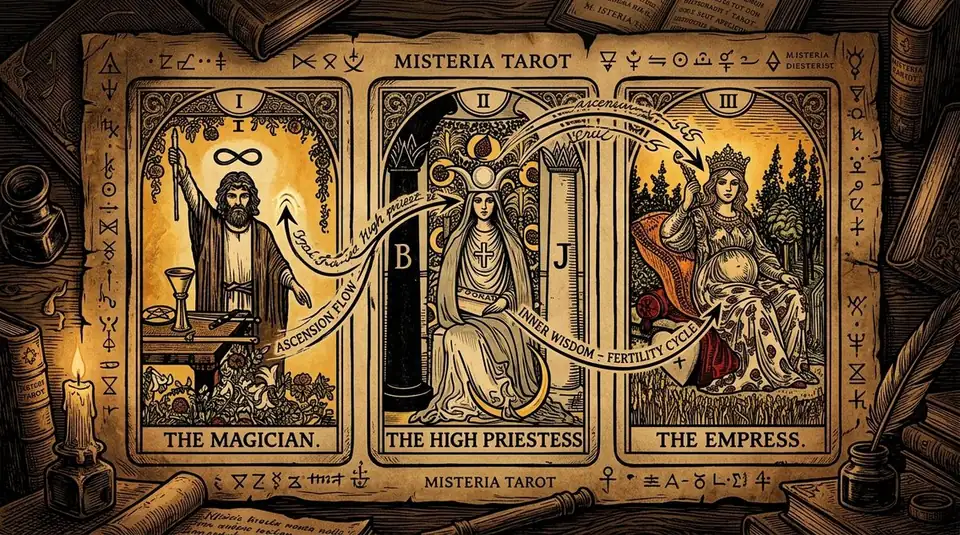
To follow the tarot spread story across the table, we must treat the layout as a storyboard. Let us examine how to track movement in both three-card and five-card spreads.
Tracking Movement in a 3-Card Spread
Let us consider a three-card layout representing a career transition: Knight of Wands (left), Ten of Wands (center), and Six of Swords (right).
A traditional keyword reading might yield: "You are passionate and energetic (Knight), but you have too much work (Ten of Wands), and you are traveling or moving away (Six of Swords)." This is disjointed. Instead, let us track the visual movement:
- Left Card (Knight of Wands): The Knight is charging at high speed toward the right. His vector is fiery, fast, and ambitious.
- Center Card (Ten of Wands): The Knight's charge crashes directly into the back of the figure carrying the ten heavy wands. This figure is walking slowly, head down, burdened by his load. The fast momentum of the Knight is instantly crushed under a heavy physical weight.
- Right Card (Six of Swords): The burdened figure looks toward the boatman of the Six of Swords. The boatman is moving slowly, pushing his boat across still waters toward a distant shore. The energy has shifted from high-speed fire (Wands) to slow, quiet water-borne transition (Swords).
By reading the sequence as a continuous movement, we see a clear narrative arc: The querent's ambitious, fast-paced pursuit of their goals leads directly to an overwhelming and exhausting burden, forcing them to abandon the frantic struggle and embark on a slow, quiet journey of mental recovery toward a distant shore. The movement itself tells the story of burnout and recovery.
Tracking Movement in a 5-Card Spread
In a five-card spread, we trace the primary vector from the first card (left) to the fifth card (right), noting where the flow changes speed, turns back, or stops.
Imagine a spread: Page of Pentacles (1), Three of Wands (2), The Tower (3), Four of Swords (4), and Ace of Swords (5).
- The Page of Pentacles stands looking down at his coin, completely absorbed in his study. The movement is slow and internal.
- The Page's study leads him to look up and stand as the figure in the Three of Wands, looking out toward ships on the horizon. The movement has expanded outward, looking to the future.
- This future expectation is suddenly shattered by the central card: The Tower. Figures are falling headfirst from a lightning-struck fortress. The movement is sudden, violent, and downward. The narrative flow is completely disrupted.
- Immediately following the fall of the Tower is the Four of Swords. A figure lies completely still, eyes closed, hands in prayer on a stone tomb. The violent downward fall has been replaced by absolute immobility and sanctuary. The movement has stopped.
- Finally, the Ace of Swords shows a single hand emerging from a cloud, holding a double-edged sword upright. The immobility of the tomb gives rise to a single, sharp, upward vector of clarity and truth.
The story is clear: A slow period of study (Page) expands into future planning (Three of Wands), only to be shattered by a sudden, disruptive crisis (The Tower). This crisis requires the querent to enter a state of complete rest and mental retreat (Four of Swords) before they can find the sharp, decisive clarity needed to build a new path (Ace of Swords).
The Four-Step Movement Method: Turning Motion into Narrative
To help you combine cards on your own table, we have developed a structured, four-step method for reading the kinetic flow of any spread. This method expands upon the relational techniques outlined in our guide on how to turn tarot cards into one sentence. Let us break down the steps:
Step 1: Identify the Primary Direction
Lay your cards out from left to right. Before reading any card definitions, trace the gaze and movement of the figures. Are the majority of the figures looking to the left (toward the past or internal states) or to the right (toward the future or external action)? Note if there is a dominant directional vector in the spread.
Step 2: Locate the Interruption or Block
Look for the card where the directional flow stops or reverses. Is there a card where a figure turns their back on the rest of the spread? Is there a card that features a wall, a blindfold, or a horizontal barrier? This point of interruption is the pivot point of the reading. It is where the client's current path is challenged or modified.
Step 3: Name the Change in Pace
Observe the speed of the cards. Are you moving from fast cards (Wands, Knights, Chariot) to slow cards (Pentacles, Four of Swords, Hermit)? Name the shift in velocity. A transition from fire to earth suggests a slowing down, grounding, or delay. A transition from earth to fire suggests a sudden acceleration or ignition of action.
Step 4: Form the Narrative Sentence
Combine these observations into a single, cohesive sentence that describes the journey of the energy across the table. Use verbs that match the kinetic quality of the cards. By translating visual movement into grammatical relations, you build a sentence that explains the dynamics of the situation with clarity and precision. This synthesis is detailed in Codex VII: The Tarot Combination Method (available on Codex VII Kindle and in Codex VII paperback).
Frequently Asked Questions
What if a card has no figures? How do I find its movement?
When a card has no human figures (such as the Ten of Swords), the movement is represented by the architecture or the environmental lines. Look at the lines of the swords, the flow of the water, or the direction of the clouds. These lines establish a visual vector that the neighboring figures must interact with. For example, the swords in the Ten of Swords point straight down, indicating a final, crushing downward force that halts all movement beneath it.
How do reversed cards affect the direction of movement?
In the Codex system, a reversed card represents a disruption in the natural flow of energy—it is blocked, internalized, delayed, or excessive. Visually, a reversal turns the card upside down, which alters the gaze direction and the movement vectors of the figures. If an upright Knight of Wands charges to the right, a reversed Knight may be seen as falling off his horse or charging backward, indicating that the action is misdirected, blocked, or retreating. For a complete study of reversals, consult Codex I and Codex VII.
What if the figures in a spread are facing each other?
When figures face each other, it creates a high-tension zone of mutual engagement. The movement is not linear; instead, it is a face-to-face confrontation, negotiation, or alignment. The energy is held between the two cards, suggesting that the resolution of the reading requires a direct encounter or dialogue between the forces represented by the cards.
Can a spread have too much movement?
Yes. If a spread consists entirely of fast, highly kinetic cards (such as multiple Knights, the Chariot, and the Eight of Wands), it indicates a situation that is moving too quickly, lacks stability, and is prone to chaos or burnout. In these cases, the advice of the reading is often to look for a static card or element that can provide anchoring stability.
Continue the Method
To master the relational grammar of tarot, including movement dynamics, visual sightlines, and sequence-based spreads, explore these essential volumes of The Tarot Codex series: