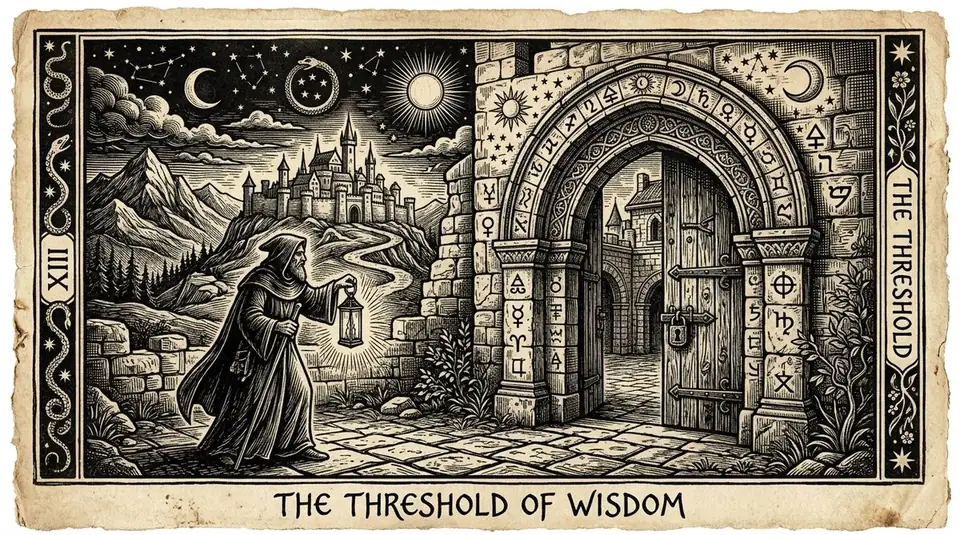
In the visual cartography of the tarot, the landscape is rarely an unbroken wilderness. Across the Major and Minor Arcana, the natural world is systematically partitioned, defended, and organized by stone and timber. We see fortress walls rising on distant cliffs, stone archways heavy with ivy, columns framing the sky, and closed doors guarding unseen inner chambers. These architectural elements are not mere background decorations. They form a deliberate symbolic boundary system—a visual grammar of exclusion, protection, and transition.
To read the cards with the diagnostic depth championed by The Tarot Codex, we must recognize that architecture represents the human impulse to divide space, to separate the "inside" from the "outside," the sacred from the profane, and the protected ego from the chaotic unconscious. When we analyze walls, gates, and doors, we are mapping the querent's current boundaries. We ask: where are they defending their position? Where are they locked out? And what thresholds are they preparing to cross?
Architecture as a Symbolic Boundary System
Space is psychological in the tarot: an open field represents potential and exposure, while a built space represents control. In the language of symbols (as explored in our guide to Tarot Symbols Explained), architecture represents the structural aspect of the mind, the ego's attempt to build order. A stone wall is solid and deliberate, creating a division in the field of experience. Looking at architectural structures, we observe how the seeker has structured their reality—whether these structures protect development, or whether they have become rigid cages isolating them from life.
The Silent Sentinels: Walls That Protect
Walls are primary symbols of containment and safety. They defend a space against external intrusion, preserving what is valuable within. In their positive aspect, walls allow for the concentration of energy, the cultivation of resources, and the establishment of a secure foundation.
Consider the King of Pentacles. He sits on a dark throne carved with bull heads, backed by a massive, grey stone castle wall. Here, the wall represents the stabilization of the Earth element. It is the fortress of material success, indicating that the king has successfully defended his realm, built lasting security, and established a stable sanctuary for his wealth. The wall is the physical manifestation of his achievement, a structural shield that ensures the longevity of his legacy.
Similarly, in the Queen of Pentacles, a low, dense hedge or stone boundary protects her fertile garden, ensuring that her nurturing energy is not trampled by external demands, preserving the cultivated self from the wild forces of the forest.
In the Sun card, a child rides a white horse in front of a high, red-brick wall. In the Codex system, this wall represents a protective enclosure keeping the complexities of adult life at bay. It is the sanctuary of the sacred child, where joy can be experienced in its pure state because it is shielded from the outer world. The wall does not imprison; it protects the delicate flame of new life and play.
Conversely, the Four of Pentacles shows a figure with a city wall in the background. Here, the wall represents the physical security of the city, but mirrors his internal state: he has walled himself in to protect his assets, turning security into a self-imposed prison of isolation.
The Masonry of Isolation: Walls That Imprison
While walls protect, they can also confine. The same stone that keeps out a predator can trap the occupant within, or shut out those who desperately need shelter. When a wall becomes too high, it represents psychological defense mechanisms that have outlived their usefulness.
In the Five of Pentacles, two impoverished figures walk through the snow, passing beneath the glowing stained-glass window of a church. The stone wall of the church is a barrier of exclusion. It represents the institutional wealth and spiritual warmth that remains tantalizingly visible but physically inaccessible to those on the outside. The wall becomes an instrument of rejection, emphasizing the division between the comforted and the exposed. The figures do not seek to breach the wall; they walk past the very structure that could save them.
The Tower is the ultimate symbol of the wall as an imprisonment of the ego. The stone tower, built on a precipice, represents a defensive structure constructed to withstand change and isolate the self from natural cycles. It is a wall of pride, built to elevate the ego. Because the walls are too rigid to bend, they must be shattered. The lightning strike is a violent, necessary liberation from a self-imposed prison of masonry. The destruction of the wall is painful, but it is the only way the captives can be freed to touch the ground once more.
In the Eight of Swords, a bound and blindfolded figure stands in the mud. In the background, on a high cliff, sits a castle. That distant castle, with its stone walls and battlements, represents the structure she has left behind. It is the source of the rules and judgments that now bind her mind. The wall here is a symbol of the rigid societal or familial structures that exile those who do not conform, leaving them to wander in the cold marshes of self-doubt.
The Portals of Transition: Gates That Invite
A gate is a wall with a choice. It is a point of controlled access, allowing passage between two distinct domains. Gates invite the traveler to step out of the familiar and enter the unknown, marking the transition from one state of consciousness to another.
In the Ace of Pentacles, a hand emerges from a cloud, holding a golden coin. Below, a path leads through a lush, green archway or gate made of flowering vines. This gate is an invitation. It represents the opening of a new path of material opportunity. It suggests that the boundary between potential and reality has been breached, and the seeker is invited to walk through the threshold into a fertile, productive future.
The Moon features a path that winds from a dark pool, between two distant, grey stone towers, and disappears into the blue mountains beyond. These towers act as a gateway. In the visual language of tarot, they represent the threshold of the deep psyche. To walk the path of the Moon is to pass through this gate, leaving the safe, familiar shores of the conscious ego and entering the wild territories of the subconscious mind. The gate is open, but it leads into a landscape of shadow and illusion.
In the Rider-Waite-Smith Death card, we see two towers on the horizon, framing a rising sun. This is the gateway of final transition and rebirth. The skeleton rider clears away the old structure so that the traveler can pass through the gate toward the light of a new dawn. It is a portal that cannot be avoided; the old must die so that the seeker can walk through the gate of renewal.
The Ordeals of Passage: Gates That Test
Not all gates are welcoming. Many are guarded by monsters, riddles, or trials, requiring the traveler to prove their readiness before passing. These gates represent the challenges of initiation, where the seeker must demonstrate mastery before they are granted access to higher levels of understanding.
The Wheel of Fortune is framed by four winged figures in the corners, each studying an open book. These figures are the guardians of the cosmic threshold, representing the fixed laws that govern the cycles of life. The gate they guard is the Wheel itself—a portal of change that tests the seeker's ability to remain centered amidst the turning of fate.
In the Chariot, the charioteer stands in front of a city wall. To move forward, he must steer his vehicle out of the city gates. The gate represents the boundary of his domestic comfort and early training. The test is one of control: can he direct the opposing black and white sphinxes to pull him through the gate and into the wider world, or will he remain stuck at the threshold? The gate tests his willpower and focus.
The Sealed and Unsealed: Closed Doors vs. Open Thresholds
The door is the most personal architectural element. Unlike a gate, which often demarcates large territories, a door belongs to the intimate spaces of the home, the temple, or the tomb. A closed door represents secrets, hidden knowledge, or blocked access; an open threshold represents opportunity, vulnerability, and integration.
The High Priestess sits before a veil suspended between two columns, Boaz and Jachin. The veil, decorated with pomegranates and palms, acts as a closed door to the temple of mysteries behind her. She sits directly on the threshold, guarding the entrance. The veil represents secret knowledge, the unconscious, and the mysteries of the feminine. It is a closed door that cannot be opened by force; it requires initiation, intuition, and patience.
In contrast, the Ten of Pentacles shows an elderly man sitting in an archway leading into a bustling courtyard. The archway is completely open, allowing children, dogs, and adults to pass freely. This open threshold represents the seamless integration of the family estate with the wider community. It suggests a state of wealth and security so established that it no longer needs defensive walls or closed doors. The open threshold is a symbol of legacy, hospitality, and trust.
Distant Cities and Temples: The Horizon of Aspiration
Often, the architecture in tarot is not immediate; it sits on the horizon as a cluster of towers or a castle. These distant structures represent the destination or goal the seeker strives toward, motivating the traveler's journey across the wild landscape.
In the Ace of Wands and the Knight of Wands, a distant castle sits on a hill. This castle represents the realization of the creative spark—the structure that will eventually house the fire of ambition. It gives the wanderer a target, a place of safety and achievement to reach. In the Page of Cups, the castle in the background suggests the emotional security and social structure that the Page is learning to navigate.
Conversely, in the Seven of Cups, one of the floating chalices contains a castle, representing the illusion of security or the temptation of power. The distant city here is a phantom, a warning that not all structures on the horizon are real or stable. When reading distant cities, we must ask: is the seeker chasing a realistic goal, or are they projecting their desires onto a distant, unreachable castle in the sky?
The Figure and the Boundary: Posture and Access
To read architectural symbols with accuracy, we must observe how the figures in the card interact with the boundaries around them. The body's posture reveals the psychological reality of the boundary.
- Facing the Wall: If a figure stands close to a wall, facing it directly, they are experiencing a block. This posture represents a fixation on obstacles, a state of psychological defense where the seeker is staring at their limitations rather than looking for a gate.
- Back to the Wall: If a figure stands with their back to a wall, they are using the structure for support. This posture represents a stable defense, indicating that the seeker is prepared to face the world because their rear is protected by solid structure.
- Standing at the Threshold: If a figure stands directly in a gateway or door, they are transitional agents. They hold the key to access, mediating between two states of being. Their posture is often poised, indicating a choice: will they step forward into the new domain, or retreat to safety?
- The Absence of Boundaries: Compare the Page of Pentacles, who stands in a wide, borderless field, with the King of Pentacles, who is enclosed by heavy stone carvings and castle walls. The Page represents limitless possibility; the King represents the heavy weight of achievement, where every choice has built a wall that defines his realm.
Spread-Level Dynamics: Repeating Boundaries
When conducting a multi-card reading, the repetition of architectural boundaries speaks louder than any single card definition. We must look at the spread as a complete structural field, observing whether the cards are open to one another or separated by walls.
A cluster of walled cards (e.g., the Four of Pentacles, the Five of Pentacles, and the High Priestess appearing together) reveals a grid of exclusion. The querent is either in a highly defensive state, shutting others out to protect themselves, or they are experiencing a profound sense of isolation, feeling locked out of emotional, material, or spiritual resources. The reading diagnoses a situation where boundaries have become too rigid, halting the flow of life and leading to stagnation. The advice is often to locate the gates or find the key to the closed doors.
Conversely, a cluster of gateway cards (e.g., the Ace of Pentacles, the Moon, and Death) indicates a profound, multi-layered transition. The querent is standing at a major crossroads of life, where old structures are falling and they are being forced to pass through successive thresholds of transformation. The reading advises them to prepare for the trials of passage, to abandon their old defenses, and to trust the process of change as they move from one room of experience to the next.
Frequently Asked Questions
What does it mean when a card shows a broken wall or collapsed gate?
A broken wall indicates a collapsed defense system. It suggests that the boundaries the querent relied on for protection have failed or been dismantled. While this can feel chaotic, it also represents an opportunity for liberation, allowing new energy to enter a space that was previously stagnant.
Does a gate always represent a positive transition?
No. A gate represents transition, but the destination depends on the card. In the Moon, the gateway leads into a dark, unstable landscape of shadow. In Death, the gate leads to rebirth but requires the ending of the old self. A gate is neutral; it is simply a point of passage.
How do I interpret walls in a reading about relationships?
In relationship readings, walls represent emotional barriers, defense mechanisms, and boundaries. A wall between two figures suggests a lack of communication or emotional distance. If one partner is walled in while the other is exposed, it diagnoses an imbalance in vulnerability and protection.
Why are towers and castles so common on the horizon of tarot cards?
Towers and castles on the horizon represent the structural goals of human life: security, achievement, power, and social status. They serve as visual anchors, showing the destination of the figures in the foreground. They remind the reader that the wanderer's journey is oriented toward the building or entering of a stable structure.
Continue the Method
To master the visual language of tarot, including physical gestures, body alignment, and symbol reading, explore these essential volumes of The Tarot Codex series: