In the theater of tarot, the arrival of a Major Arcana card acts like a sudden peal of thunder. When the Tower crumbles, the Wheel of Fortune turns, or the Emperor sits in judgment on the table, the atmosphere changes; the reader and the querent both lean forward, sensing the presence of larger, archetypal forces. These are the cards of destiny, of inevitable transitions, and of the grand, mythic patterns that shape a human life. But what happens when the deck is shuffled, the layout is dealt, and not a single Major Arcana card appears?
For many, this silent spread feels like a disappointment or even an error. It is easy to assume that a reading consisting entirely of the Minor Arcana—only Wands, Cups, Swords, and Pentacles—lacks weight. The immediate reaction is often one of worry: "Is my future blank? Is the question too trivial? Have the cards refused to speak?"
In the structural method of The Tarot Codex, we treat this absence not as a failure, but as a precise diagnostic signal. A spread containing only Minor Arcana cards is a specific kind of reading with its own unique grammar. It is a reading that has lowered its eyes from the heavens and focused them entirely on the earth. It is a signature of human agency, practical choices, and immediate textures. To read it well, we must understand the meaning of this cosmic silence and learn how to interpret the quiet, high-stakes drama of the Minor Arcana. In this guide, we will explore what it means when there is no major arcana in tarot reading, how to approach an only minor arcana tarot reading, and how to turn this silence into insight.
The Threshold and the Texture: Major vs. Minor Arcana
To understand why a reading without Major Arcana is so significant, we must first examine the relationship between the two halves of the deck in plain language. (For a broader look at this structural division, see our guide on the differences between the Major Arcana vs Minor Arcana).
The seventy-eight cards of the tarot are divided into two distinct realms:
- The Major Arcana (22 Cards): These represent archetypal forces, karmic thresholds, and spiritual trials. They are the macro-narratives of our lives—events that feel larger than our immediate control. When a Major Arcana card appears, it suggests that the situation is governed by destiny, structural transitions, or psychological initiations that must be experienced rather than avoided.
- The Minor Arcana (56 Cards): These represent the texture of lived experience. They are the micro-narratives—the day-to-day decisions, emotional reactions, intellectual arguments, and material labors that fill our waking hours. They are divided into four suits (Wands, Cups, Swords, and Pentacles) and represent our immediate actions, relationships, conflicts, and resources.
When there is no major arcana in tarot spread, the cards are telling you that the situation is currently free from the pressure of cosmic destiny. There is no archetypal threshold that you must cross. Instead, the focus of the reading is entirely on your human agency. The situation is not set in stone; it is being written, line by line, by your choices, habits, and actions.
Five Meanings of the Missing Major Arcana
Depending on the question and the client’s life situation, a reading containing only minor arcana tarot reading typically points to one of the following five dynamics:
1. Ordinary-Life Focus (The Realm of Choice)
When the Major Arcana is absent, the universe is stepping back to give you room to breathe. This is a sign of an ordinary-life focus. You are not dealing with a fateful intervention or a karmic cycle that you must passively endure. Instead, the situation is completely within your control. The cards are focusing on your daily habits, your professional projects, your communications, and your immediate feelings. The message is clear: your actions today will dictate the outcome tomorrow.
2. The Imperative of Practical Decisions
A reading without Major cards suggests that the solution to your problem is not philosophical or spiritual, but practical. You do not need to meditate on the nature of the universe or wait for a sign from the stars. You need to make practical decisions. If you are struggling with a career issue, the cards want you to look at your budget (Pentacles) or your project timeline (Wands). If you are struggling with a relationship, they want you to address your communication patterns (Swords) or your emotional boundaries (Cups).
3. The Absence of the Archetypal Threshold
Sometimes, we want our lives to be grand dramas. We want to believe that our current heartbreak is a tragic initiation (like the Tower) or that our new job is a destiny-defining call (like Judgment). When no Major cards appear, the tarot gently deflates this drama. It shows that you are not passing through a major archetypal threshold. You are simply dealing with the normal, everyday weather of being alive. This is not a slight; it is a reassurance that the stakes are manageable.
4. Details Matter More Than Destiny
In the Codex method, we emphasize that details matter more than destiny when the Major Arcana is silent. Rather than looking for a grand, overarching theme, you must zoom in on the specific cards, elements, and gestures in the spread. A subtle glance between a Page and a Knight, or a minor imbalance between Wands and Cups, carries the key to the entire reading. The solution lies in the small things—the details of how you work, how you speak, and how you feel.
5. The Narrow Scope of the Query
We must always consider the scope of the question. If a client asks, "How should I organize my desk for maximum productivity?" or "What should I expect on my weekend trip?", a lack of Major cards is healthy and expected. It shows that the scope of the query is narrow. In these cases, the absence of the Major Arcana is not a sign of a superficial reading, but a sign of healthy contextual alignment. The cards are matching the level of the question.
The Fallacy of the "Unimportant" Reading
One of the most common mistakes a reader can make is assuming that an all-Minor spread is unimportant or trivial. This is a profound misunderstanding of the tarot. We do not live our lives in the Major Arcana; we live them in the Minor.
While the Major Arcana names the grand milestones of our existence—birth, death, spiritual awakening, and major transitions—these moments are rare. The vast majority of our lives are spent in the Minor Arcana. We spend our days working (Pentacles), talking (Swords), feeling (Cups), and striving (Wands). It is in these daily, minor moments that our character is forged and our future is built.
When you ask what does no major arcana mean, remember that the Minor Arcana is where the real work of life takes place. An all-Minor reading is not a secondary or lesser reading; it is a highly concentrated, actionable diagnostic of your current reality. It tells you exactly where your energy is flowing and where it is blocked, offering you a roadmap for immediate, practical change.
Cosmic Saturation vs. Practical Agency: The Comparative Spread
To see this dynamic clearly, it is useful to compare a spread dominated by the Major Arcana with one containing only the Minor.
| Spread Composition | Primary Focus | Level of Agency |
|---|---|---|
| Major-Dominant Spread | Archetypal themes, destiny, karmic lessons, major transitions beyond immediate control. | Low Agency: The querent must yield to the larger forces at play, learn the lesson, and adapt to the changing tide. |
| Minor-Only Spread | Practical decisions, habits, actions, emotional responses, and day-to-day work. | High Agency: The querent is the author of the outcome. Immediate choices and actions will directly shape the future. |
A major-dominant spread represents a time of cosmic saturation—you are caught in a current that you did not start and cannot easily stop. A minor-only spread represents a time of practical agency. The steering wheel is in your hands, and the cards are showing you the road conditions.
Case Studies in the Minor Key
Let us look at how the complete absence of Major Arcana cards alters the meaning of a reading across three common areas of life:
Example 1: A Career Dilemma with Only Minor Arcana
A client asks: "How can I resolve the tension with my business partner?"
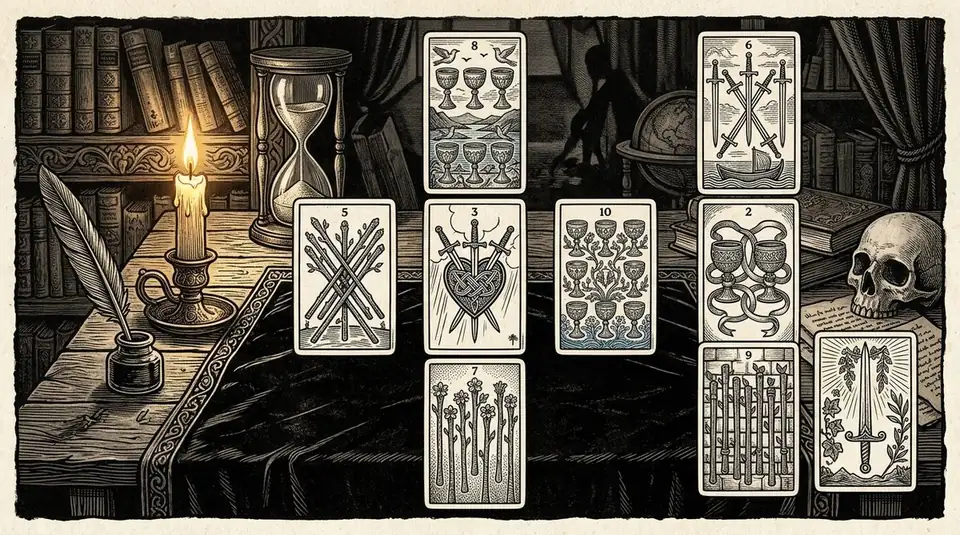
The cards drawn: Three of Pentacles, Seven of Swords, Eight of Wands.
Analysis: In this spread, we see a focus on Earth (Pentacles/collaboration), Air (Swords/tactics or boundaries), and Fire (Wands/rapid communication). There are no Major Arcana cards. This indicates that the partnership is not facing a fateful collapse or a destined ending. The tension is entirely a matter of practical workflow and communication. The Three of Pentacles shows that the foundation of the work is solid, but the Seven of Swords warns that someone is acting defensively or keeping information hidden. The Eight of Wands suggests that rapid, direct, and honest communication is needed immediately. The absence of Major cards tells the client: "This is not a tragic end to your business. Do not walk away. Pick up the phone, address the specific work breakdown, and clarify the boundaries."
Example 2: A Relationship Query with Only Minor Arcana
A client asks: "Should I commit to this new relationship?"
The cards drawn: Page of Cups, Five of Pentacles, Four of Swords.
Analysis: Here we see a soft emotional opening (Page of Cups), a feeling of scarcity or fear of abandonment (Five of Pentacles), and a need for mental withdrawal or quiet boundaries (Four of Swords). Because there is no Major Arcana like The Lovers or The Devil, this relationship is not a "soulmate union" or a karmic trap. It is simply a human connection with practical emotional challenges. The Page of Cups shows genuine affection, but the Five of Pentacles reveals that both partners are bringing a fear of lack to the relationship. The Four of Swords advises taking a quiet pause to rest and evaluate these fears before making a heavy commitment. The reading suggests: "The future of this relationship is not predetermined by destiny. Take your time, heal your practical emotional wounds, and proceed step-by-step."
Example 3: A Decision Reading with Only Minor Arcana
A client asks: "Should I move to a different city next month?"
The cards drawn: Two of Wands, Five of Wands, Ten of Pentacles.
Analysis: This spread shows a choice of direction (Two of Wands), an environment of competitive struggle or minor conflicts (Five of Wands), and a long-term goal of financial and familial security (Ten of Pentacles). With no Major cards present, the move is not a fateful event that will change the course of the client's life forever. It is a highly practical decision. The Two of Wands shows they are standing at the gate, planning the path. The Five of Wands warns that the initial transition will involve a lot of small, irritating struggles and logistics. The Ten of Pentacles shows that the long-term material stability is there if they put in the work. The advice is: "Do not wait for a cosmic sign. Weigh the practical pros and cons of the move, prepare for the logistical chaos of the transition, and make a decision based on your material goals."
Frequently Asked Questions
Does 'no Major Arcana' mean a reading is less accurate or important?
No. An all-Minor reading is just as accurate and important as any other. It simply operates on a different frequency. Instead of focusing on large, unyielding archetypes, it focuses on your personal agency and the concrete steps you can take to change your situation. It is a reading of action and choice, rather than passive destiny.
What if I get only Minor Arcana when asking about a major life decision?
This is actually a very empowering sign. It suggests that even though the decision feels huge, you are not bound by a fixed destiny. You have the freedom to choose your path. The outcome is not written in the stars; it will be built by your day-to-day execution, your emotional honesty, and your practical planning.
How can I identify the core theme of a reading without Major cards?
In the method of The Tarot Codex, when the Major Arcana is silent, you must look to the dominant suit and the number patterns. If your spread is dominated by Swords, the core theme is mental boundary and decision. If you see multiple Fours, the theme is stability, structure, and containment. The structure of the Minor Arcana itself becomes the anchor of the reading.
Can a reading with no Major Arcana still show spiritual growth?
Yes. Spiritual growth is not confined to the Major Arcana. In fact, true spiritual integration often happens when we apply our higher principles to the mundane details of the Minor Arcana—how we handle a difficult conversation (Swords), how we manage our money (Pentacles), or how we show up for a friend (Cups).
Continue the Method
To study the deeper grammar of elements, suits, and Minor Arcana structure, explore these essential volumes of The Tarot Codex series: